Here is part 2. The clips about Martial Arts look more like Ju Jitsu than they do Tai chi. Then at the end he says why ! Hope he succeeds !
Friday, October 26, 2007


Josh Waitzkin: The Art of Learning on ABC News - Part 1
This is the first of 2 videos on a chess master who also is into Martial Arts. He has a book out about the learning processes behind both. I want this.
I know this isnt about the wooden dummy - but I have to make an exception - because I have an interest in chess too and the learning process too. So should you. There is a debate out there about 'transferable skills' / 'sports specific' skills etc. in learning. Search for transferability in what you do. Get a pair of eyes that see ideas in other disciplines. Be a magpie don't be like water - as you fit into someone else cup.
Monday, October 15, 2007
Friday, September 28, 2007
Who Do You Believe?
Look at these three pictures. They are from a known Wing Chun book that has positive reviews, (Alan Gibson Simple Thinking Intelligent Fighters); and a JKD book that has positive reviews, (Teri Tom The Straight Lead). I know this post is not about the Wooden dummy but I wanted to make the point.
Here the Wing Chun stance takes forward pressure.

Now look at this picture from Tom - same stance - similar test - different result ! The JKD stance is solid but the Wing Chun stance buckles under a palm. Mmmmmm.


This is Ted Wong here, too, involved. He was Bruce Lee's training partner. And he appears in Randy Williams' Wing Chun training videos so he no stranger to these issues.
So what's going on ? What sense are we to make of all this ?
The point is how when you crosscheck your information in martial art research you sometimes get 2 different answers. I have seen this Wing Chun stance pressed forward so I know it can withstand some pressure. Alan Orr - a MMA inclined Wing Chun player - has this useful drill that is worth checking out below. I adapted it from his www page just to examine a point :
http://www.alanorr.com/htdocs/articles/wcpowerarticle.html

I may invite all 3 authors - Gibson, Tom / Wong and Orr - to reply to what they see here and explain what the issues are involved here.
It would be interesting to get feedback from each of these experts: to explain how the same forces applied to the same structures yield different results ! What is it I am missing here ?
PS. ON reflection this should be telling us to pressure test the knowledge we are given and double-check it. Take nothing on trust alone. If the Wing Chun stance takes time to perfect and eek out its nuances then I can imagine the JKD comparison being 'accepted' by the student as 'true'. I am not in a position to judge properly what is 'true' here. I may have missed a point. But I suspect this example isn't isolated in martial art literature. (It isn't isolated in chess literature. You get the same positions on the board sometimes evaluated differently - it drives you nuts if you 'need' your answers given to you).
Here the Wing Chun stance takes forward pressure.

Now look at this picture from Tom - same stance - similar test - different result ! The JKD stance is solid but the Wing Chun stance buckles under a palm. Mmmmmm.


This is Ted Wong here, too, involved. He was Bruce Lee's training partner. And he appears in Randy Williams' Wing Chun training videos so he no stranger to these issues.
So what's going on ? What sense are we to make of all this ?
The point is how when you crosscheck your information in martial art research you sometimes get 2 different answers. I have seen this Wing Chun stance pressed forward so I know it can withstand some pressure. Alan Orr - a MMA inclined Wing Chun player - has this useful drill that is worth checking out below. I adapted it from his www page just to examine a point :
http://www.alanorr.com/htdocs/articles/wcpowerarticle.html

I may invite all 3 authors - Gibson, Tom / Wong and Orr - to reply to what they see here and explain what the issues are involved here.
It would be interesting to get feedback from each of these experts: to explain how the same forces applied to the same structures yield different results ! What is it I am missing here ?
PS. ON reflection this should be telling us to pressure test the knowledge we are given and double-check it. Take nothing on trust alone. If the Wing Chun stance takes time to perfect and eek out its nuances then I can imagine the JKD comparison being 'accepted' by the student as 'true'. I am not in a position to judge properly what is 'true' here. I may have missed a point. But I suspect this example isn't isolated in martial art literature. (It isn't isolated in chess literature. You get the same positions on the board sometimes evaluated differently - it drives you nuts if you 'need' your answers given to you).
Silat Suffian Bela Diri - Kuntao (Empty Hands) Mook Jong
Look at this - a Silat man using some shapes on the dummy.
Other than Joseph Simonet this is the only time I have seen a Silat man use a wooden dummy. Applications need showing ideally.
The use of the drills seem to be mainly conditioning - eg the ones that bash the arms @ 90 o angles nearly. But there are some moves that sheer along the arms. Believe me these are sought after moves when training after a while as you save your arms from destruction.
Sunday, September 23, 2007
Sifu Chung Kwok Chow Wooden Dummy
Here is a video that illustrates the traingle idea that I drew below and that Randy Williams uses in his drills video on the dummy. Its a 'male triangle' in Kali speke.
Friday, September 14, 2007
Stopping The Shoot ?
When I tried to spar recently I found it really really hard to stop the shoot for my legs. MMA people are good at this - ie they change the level. Wing Chun doesn't.
I thought maybe this idea could be worked either on the bottom arm or the leg even ! You simulate pummeling for under-hooks [I need to keep elbows in here] and then drop your hips a level and shift your legs back. You're meant to simulate the force driving you back as you prevent your hips being forced back and your legs grabbed.
I was a bit half-hearted in this as I didn't want my hands to slip and break my face but with practice I bet you could get quite aggressive on this and even drop to the dummy leg level. It is just an idea. ( I wanted to give it a try to drop to leg level but the camera would need readjusting and it was getting dark).
I thought maybe this idea could be worked either on the bottom arm or the leg even ! You simulate pummeling for under-hooks [I need to keep elbows in here] and then drop your hips a level and shift your legs back. You're meant to simulate the force driving you back as you prevent your hips being forced back and your legs grabbed.
I was a bit half-hearted in this as I didn't want my hands to slip and break my face but with practice I bet you could get quite aggressive on this and even drop to the dummy leg level. It is just an idea. ( I wanted to give it a try to drop to leg level but the camera would need readjusting and it was getting dark).
Low Kicks on the Weeble
Here are some Wing Chun type kicks on the dummy. They are low line kicks. They are straight line and I know they are awkward to deal with. I am wearing my safety shoes while doing this. The heel takes the force so Wing Chun slippers would not be up to this.
If you cant tell by now I don't take myself too seriously - the Weeble [tm] stuff etc.
If you cant tell by now I don't take myself too seriously - the Weeble [tm] stuff etc.
Straight blasting the Weeble [tm]
"When in doubt straight blast". I think Bruce Lee is attributed with this phrase. When I saw these punches I thought they looked like Rabbit punches. I know JKD uses these too as well as Wing Chun.
The Straight Blast gym under Matt Thornton use boxers crosses in fast succession not this type of punching I am doing. That is really harder to do and is really committed body weight forward top half.
I know this punching makes people flinch at least. I throw in elbows too on the pads. The punching isn't an end in itself.
The Straight Blast gym under Matt Thornton use boxers crosses in fast succession not this type of punching I am doing. That is really harder to do and is really committed body weight forward top half.
I know this punching makes people flinch at least. I throw in elbows too on the pads. The punching isn't an end in itself.
Weeble Dummy [tm] ?
In a conversation with a learned colleague the wing chun dummy doesn't 'give' and can be limited for some martial art applications. This was a reason why one of his Wing Chun friends had stopped using it in favour of a punch bag.
I am a fan of the dummy so set about creating the 'Weeble Dummy' [tm]. Ahahaha. Seriously I know that my dummy can be made to give 'if' you remove the wedges from the corners of the trough its in / and / or put it on bricks. I put my dummy on bricks to stop it getting too muddy and stuck in there. Also it heightens it when I want it higher. THAT is heresy I know to traditional wing chunners who like it low so their stance is low and legs bent. Joseph Simonet in his Slam Set dummy said his dummy is modified as he is is taller and not expecting small people to fight him (actually he didn't say it like that but you know what I mean).
In another Blog on wing chun [see below] the Classical dummy should not give 'if' you want your structure to be tested and force going back down your legs.
Anyway enough of the apologetics. I wanted the dummy to rock so I can do this drill shown on the video. The leg is taken out so I can move the whole unit with my arm and without the leg acting as a break. I put 2 x pads up for the elbowing. I could have used my Thai pad and belt to keep it up there alternatively. The dummy weighs about 13 stone. I have added extra weights on the base to make it heavier - although they may have slidden off in this drill.
I TOOK THIS VIDEO OFF. On re-watching the elbow I used looked like one from a Wing Chun stance, Lan Sau , up-right stance etc. [like a 90 degree elbow attack - I should have had a more Silat angled elbow - pointed forwards more and hand 'home' on the neck, less space between the elbow and my chest and an angled torso - ready to flick out to grab the dummy.
I am a fan of the dummy so set about creating the 'Weeble Dummy' [tm]. Ahahaha. Seriously I know that my dummy can be made to give 'if' you remove the wedges from the corners of the trough its in / and / or put it on bricks. I put my dummy on bricks to stop it getting too muddy and stuck in there. Also it heightens it when I want it higher. THAT is heresy I know to traditional wing chunners who like it low so their stance is low and legs bent. Joseph Simonet in his Slam Set dummy said his dummy is modified as he is is taller and not expecting small people to fight him (actually he didn't say it like that but you know what I mean).
In another Blog on wing chun [see below] the Classical dummy should not give 'if' you want your structure to be tested and force going back down your legs.
Anyway enough of the apologetics. I wanted the dummy to rock so I can do this drill shown on the video. The leg is taken out so I can move the whole unit with my arm and without the leg acting as a break. I put 2 x pads up for the elbowing. I could have used my Thai pad and belt to keep it up there alternatively. The dummy weighs about 13 stone. I have added extra weights on the base to make it heavier - although they may have slidden off in this drill.
I TOOK THIS VIDEO OFF. On re-watching the elbow I used looked like one from a Wing Chun stance, Lan Sau , up-right stance etc. [like a 90 degree elbow attack - I should have had a more Silat angled elbow - pointed forwards more and hand 'home' on the neck, less space between the elbow and my chest and an angled torso - ready to flick out to grab the dummy.
Sunday, September 09, 2007
2 triangles or one ?
Look take the 2 shapes below and add them in for a footwork matrix !? Good stuff eh.

Look there is no north south line. One of the things I regret is learnining to step forwards and backwards in a line mechanically. No doubt it has its place but the 'V' and '^' angles of stepping are really useful and worth in-graining early on in someone. Backwards steps are a bad habit to rely on to get out of 100% pressure. In a confrontation in public if someone is blocking your path a step diagonally forward or away would move you around - or away - from their colleague who may be behind you unbeknown to you.
The is a place for forwards and backwards lines but maybe their practice should not be moving me away from these other angles.

Look there is no north south line. One of the things I regret is learnining to step forwards and backwards in a line mechanically. No doubt it has its place but the 'V' and '^' angles of stepping are really useful and worth in-graining early on in someone. Backwards steps are a bad habit to rely on to get out of 100% pressure. In a confrontation in public if someone is blocking your path a step diagonally forward or away would move you around - or away - from their colleague who may be behind you unbeknown to you.
The is a place for forwards and backwards lines but maybe their practice should not be moving me away from these other angles.
Tuesday, September 04, 2007
Footwork - angles to think about.
Here are 2 diagrams to show footwork ideas on the dummy. These can be interpreted classically or Jeet Kune do style borrowing from Kali. Randy Williams' work on the dummy does use this type of approach from a classical view - ie body stance is upright in Moving on the 'V' or male triangle. A Kali approach angles the body away from center line however in addition.
The 'V' shape:
Here stood at point 1 a blow from the left hand side or even center can be avoided by stepping to point 2A. In Kali this is where the 'pressure' of the attack is evaded. Maximum attacking pressure is @ 1. Therefore we need to be away from point 1.
(Invert for a right handed attack ie- step from 1 to 2b).
You can experiment how tight you get to the dummy with the prefered range: in tight if you want for grappling finishes. At a distance if you have a stick / boxing / kick boxing range. In retreating you can slide back from 2A, 2B along the 'V' again. This type of retreat I notice Alan Gibson makes in his book on wing chun (vol 1). He uses garn sau hand shapes [a cutting parry - if you like but it doesnt matter (non wing chun people just think block / counter strike / cover) ] to in retreating from attack diagonally away. He likens it to zig-zagging away from a sniper bullet. The point is to avoid a step backwards in a straight line from a frontal attack. That allows pressure to build up against you in an escalating manner.
A more traditional way to see this 'V' shape is to step off to 2a and apply say bong sau / lap sau and a stamping kick to the leg of the dummy.

The 'male triangle':
Here is another method of stepping. The Yip Man form has this in the 116 movemnts and involves moving from 1a to 1b with the right leg and the left leg circles in to 1c. Once there it can sweep or kick back with the heel on the calf muscle - whatever. the point is it bisects the opponents stance by cutting in on the triangle.
Williams work on dummy drills shows another application of this triangle where hand shapes like tan sau and punch [tan da] are applied from standing square on the base line and the hand movements are applied as a leg plunges in to 1c. When I have done this I either step deep in to the base of the dummy or try to collide with the leg to impact with a clashing movement (ouch !).
Male triangle vs 'V':
The 'V' evades the attack in a counter-attacking way / the 'male triangle' is wither direct straight in (OR can be evasive but circles in too). The choice is based on (your) style and context of the conflict.
IF YOU READ THIS PLEASE COMMENT
Here are 2 diagrams to show footwork ideas on the dummy. These can be interpreted classically or Jeet Kune do style borrowing from Kali. Randy Williams' work on the dummy does use this type of approach from a classical view - ie body stance is upright in Moving on the 'V' or male triangle. A Kali approach angles the body away from center line however in addition.
The 'V' shape:

Here stood at point 1 a blow from the left hand side or even center can be avoided by stepping to point 2A. In Kali this is where the 'pressure' of the attack is evaded. Maximum attacking pressure is @ 1. Therefore we need to be away from point 1.
(Invert for a right handed attack ie- step from 1 to 2b).
You can experiment how tight you get to the dummy with the prefered range: in tight if you want for grappling finishes. At a distance if you have a stick / boxing / kick boxing range. In retreating you can slide back from 2A, 2B along the 'V' again. This type of retreat I notice Alan Gibson makes in his book on wing chun (vol 1). He uses garn sau hand shapes [a cutting parry - if you like but it doesnt matter (non wing chun people just think block / counter strike / cover) ] to in retreating from attack diagonally away. He likens it to zig-zagging away from a sniper bullet. The point is to avoid a step backwards in a straight line from a frontal attack. That allows pressure to build up against you in an escalating manner.
A more traditional way to see this 'V' shape is to step off to 2a and apply say bong sau / lap sau and a stamping kick to the leg of the dummy.

The 'male triangle':
Here is another method of stepping. The Yip Man form has this in the 116 movemnts and involves moving from 1a to 1b with the right leg and the left leg circles in to 1c. Once there it can sweep or kick back with the heel on the calf muscle - whatever. the point is it bisects the opponents stance by cutting in on the triangle.
Williams work on dummy drills shows another application of this triangle where hand shapes like tan sau and punch [tan da] are applied from standing square on the base line and the hand movements are applied as a leg plunges in to 1c. When I have done this I either step deep in to the base of the dummy or try to collide with the leg to impact with a clashing movement (ouch !).
Male triangle vs 'V':
The 'V' evades the attack in a counter-attacking way / the 'male triangle' is wither direct straight in (OR can be evasive but circles in too). The choice is based on (your) style and context of the conflict.
IF YOU READ THIS PLEASE COMMENT
Sunday, August 26, 2007
Catching-Up !
Ahhh. I typed in my name for this place on google search to see what came up. And someone had noted it. So ... this jogged me back into action here again. Thanks Dojo Rat !
I have been meaning to put up progress on here and talk about things. It gets a bit demoralising when no one replys to my messages here #but# if its being read by at least one person who goes off and ponders then its worth it. Also if it helps me reflect on ideas then this needs to be kept up.
OK. Whats new. I have been looking at footwork on the Kali / Silat side of things. Wing Chun does seem to have a paucity of official footwork so I have always been wanting to check up on the Silat side of things.
What I have been doing is stepping on a 'V' shape - first one side then the other. This gets me to the outside gate. In a way this IS what the 116 movements does in the form it makes you move from centre to flank, back to center to flank .... in a 'V' shape if you like. BUT here the 'V' Kali does just go to the edge 1st of all - not just if the center is blocked.
Also I have been stepping in on the male triangle ... imagine a pyramid pointing forwards. I have been stepping forward to the point away from me with a circle step [like in the form that goes to the leg sweep in the 116 movements.]. The legs meet at the peak of the triangle and I sweep one foot back to the corner of the base. The sweep is called a biset - it drags back to base.
I tried to make a short video of myself using the dummy for a test. The dummy had no leg on and I was just seeing what it would look like. I was really hitting the dummy hard and wacking it - showing off if you like - and on the video you cant pick this up at all really ! I have more respect now for the videos I see on places like youtube. I bet these guys do really have some force in there that doesn't come across on that medium.
Using the dummy without the leg plugged in is very useful. I have reconfirmed this after watching Jospeh Simonet's slam set tape I have. It lets you do things that are prohibited by the 'official' form or space wise - like stand toe to toe and 'pummel' like grapplers for underhook.
I will post some pics here of other training things I have done or attempted and gave up!
I have been meaning to put up progress on here and talk about things. It gets a bit demoralising when no one replys to my messages here #but# if its being read by at least one person who goes off and ponders then its worth it. Also if it helps me reflect on ideas then this needs to be kept up.
OK. Whats new. I have been looking at footwork on the Kali / Silat side of things. Wing Chun does seem to have a paucity of official footwork so I have always been wanting to check up on the Silat side of things.
What I have been doing is stepping on a 'V' shape - first one side then the other. This gets me to the outside gate. In a way this IS what the 116 movements does in the form it makes you move from centre to flank, back to center to flank .... in a 'V' shape if you like. BUT here the 'V' Kali does just go to the edge 1st of all - not just if the center is blocked.
Also I have been stepping in on the male triangle ... imagine a pyramid pointing forwards. I have been stepping forward to the point away from me with a circle step [like in the form that goes to the leg sweep in the 116 movements.]. The legs meet at the peak of the triangle and I sweep one foot back to the corner of the base. The sweep is called a biset - it drags back to base.
I tried to make a short video of myself using the dummy for a test. The dummy had no leg on and I was just seeing what it would look like. I was really hitting the dummy hard and wacking it - showing off if you like - and on the video you cant pick this up at all really ! I have more respect now for the videos I see on places like youtube. I bet these guys do really have some force in there that doesn't come across on that medium.
Using the dummy without the leg plugged in is very useful. I have reconfirmed this after watching Jospeh Simonet's slam set tape I have. It lets you do things that are prohibited by the 'official' form or space wise - like stand toe to toe and 'pummel' like grapplers for underhook.
I will post some pics here of other training things I have done or attempted and gave up!
Thursday, December 07, 2006
Elbows, Knees And Kicks And Confidence Stuff.
I went to Vale Tudo the other day after a break of many, many months. I did this because I don't attend any clubs anymore and this was a gathering of people I knew semi-formally.
One bad habit I had that was revived was trying to deal with low kicks with my hands and arms. This is a really hard habit to break. I thought I had broken it but its come back.
I had a think and I believe its the dummy form that encourages this. When moving across the dummy, there are double garn-sau to kwan sau transitions. The double garn saus must be in there affecting me. I need to erase this but may have to drop the double garn saus [these are pictured in the DVD cases in posts below - it must be dramatic or something].
Why doesn't the Yip-Man lineage dummy form include knees or leg blocks to kicks ? Only the one performed by Randy Williams includes some knee and leg defenses. I must transplant some of these into what I do and / or drill them. (He has a bong gerk type move to the lower dummy arms too - if I recall).
Also whats not in the 116 movements are elbows. Why arn't these in the form ? You don't have to strike the dummy but can simulate. Space could be made for this by removing the tok sau moves that are over-represented, (be honest do you envisage using double-tok sau in a confrontation ?!)
Is this heresy ? Does it matter if you mess with tradition ?
Also while I am at it all my Wing Chun stuff goes out my head when in Vale Tudo. I would have to consciously tell my self 'I know some wing chun shapes' to use them. This is funny because when not doing Vale Tudo - say if I am frightened by something then wing chun shapes emerge. I wonder why this is.
Actually one wooden dummy move does look like a Vale tudo move. The circling hands of the 116 form (kau saus ?!) do look like pummeling for under-hooks in vertical grappling.
I go through ups and downs in faith in my dummy / WC skills. I don't think I would last that long in a traditional WC method vs Vale Tudo style approach. A skilled player can close the range so fast they are chest to chest straight from boxing range - with no in-between it seems. And then they dive to a lower level like a U-boat. Some fast footwork must be needed to counter this to keep the range or something.
One bad habit I had that was revived was trying to deal with low kicks with my hands and arms. This is a really hard habit to break. I thought I had broken it but its come back.
I had a think and I believe its the dummy form that encourages this. When moving across the dummy, there are double garn-sau to kwan sau transitions. The double garn saus must be in there affecting me. I need to erase this but may have to drop the double garn saus [these are pictured in the DVD cases in posts below - it must be dramatic or something].
Why doesn't the Yip-Man lineage dummy form include knees or leg blocks to kicks ? Only the one performed by Randy Williams includes some knee and leg defenses. I must transplant some of these into what I do and / or drill them. (He has a bong gerk type move to the lower dummy arms too - if I recall).
Also whats not in the 116 movements are elbows. Why arn't these in the form ? You don't have to strike the dummy but can simulate. Space could be made for this by removing the tok sau moves that are over-represented, (be honest do you envisage using double-tok sau in a confrontation ?!)
Is this heresy ? Does it matter if you mess with tradition ?
Also while I am at it all my Wing Chun stuff goes out my head when in Vale Tudo. I would have to consciously tell my self 'I know some wing chun shapes' to use them. This is funny because when not doing Vale Tudo - say if I am frightened by something then wing chun shapes emerge. I wonder why this is.
Actually one wooden dummy move does look like a Vale tudo move. The circling hands of the 116 form (kau saus ?!) do look like pummeling for under-hooks in vertical grappling.
I go through ups and downs in faith in my dummy / WC skills. I don't think I would last that long in a traditional WC method vs Vale Tudo style approach. A skilled player can close the range so fast they are chest to chest straight from boxing range - with no in-between it seems. And then they dive to a lower level like a U-boat. Some fast footwork must be needed to counter this to keep the range or something.
Thursday, November 23, 2006
Same But Different ?


I am interested in the wooden dummy for this blog but this is a general issue of Wing Chun that goes beyond the dummy. It's the disputes within Wing Chun over how one way is 'the' way and everything else is modified.
I had a good replay to a question on the AWCAOnline blog that you should be looking at - if your not already. I asked Phil Bradley its proprietor why footwork is an issue in dividing Wing Chun schools.
see here :
http://awcaonline.com/blog/?p=69#comments
His reply reminded me of the issue of relativism in the philosophy of Science and Thomas Kuhn's issue of Paradigms. This was derived from astronomy, but the point here is how different interpretations can be seen to be true, relative to the 'framework' they are applied with.
Phil made the point that different moves 'work' within different frameworks of footwork, [paradigms if you like]. The moves are 'true' relative to the way they are trained in the specific location / school that spawned them. Outside of this they may not be 'true', given a different 'paradigm'. IE a different school cannot utilizes their moves as their foundation is different and not optimized for those moves.
An issue here is they are same Wing Chun family but a slight difference in a variable yields new consequences. The impact this has on the 'scientific' street fighting is a cultural one - politics occurs around the 'truth'.
I am including 2 pictures here of 2 airplanes. They belong the same family of planes but they differ structurally but were capable of performing a 'fighting' function:
Here is a conventional design.
Spitfire:


This is the Blohm and Voss 141. It was a viable plane design:
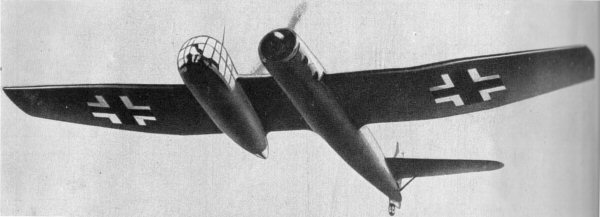
So what's the point. They both 'work' but are different too. (Check the link on youtube if you dont believe the above plane flew: http://www.youtube.com/watch?v=9JAH6CiOu0w) .
Which is the 'true' plane ? Which disobeys the laws of flight ?
Friday, November 17, 2006
Bruce Lee and the Dummy
Here is an article from kungfiMagazine.com
I include this because it enlightens us to alternative uses of the dummy and some innovative ways to use it and train. This is thinking outside the box stuff and if you're not used to this the nit will cause discomfort or fascination.
- The dummy 'form' is split up into 'sets' of moves 1 to 12, that can be juggled
- The juggling of the 'sets' allows for more free-play of the moves vs application in a linear way. E.g. start at set 7 and then move to 2, rather than work from set 1 to 7.
- The dummy can be used like a punch bag to practice angles, leverage, movement, accuracy
I would love to have seen a film of Bruce Lee on the Dummy it would be really enlightening indeed.
There are some videos - very rare - of the Bruce Lee Jun Fan sets - 10 sets of movements that look like modified Wing Chun. And then another 10 Jeet Kune Do sets that have moved away from Wing Chun-style and are more dynamic (by this I mean less upright structure and use of space to zone in and out and around the dummy is more varied).
I wonder why Inosanto hasn't published material on these sets and their use or a video on them ?
(I will review the tapes I have on these in another post- the are by a Spanish practitioner)
http://ezine.kungfumagazine.com/magazine/article.php?article=92
Worth reading.
Wednesday, November 15, 2006
research ...
MMMmmm. In relation to the 1st link on youtube below I emailed an instructor on a Wing chun web site who is skilled in distance learning. I did this to see what he would say about the 116 movements and how he interpreted it.
He didnt agree with the way the criticisms were formed but there were some grains of truth he felt.
I re-looked myself and yes its not perfect: he does seem to lean in for the butterfuly hands - but I see instructional DVDs 'masters' doing that too - he he isnt alone. He thought too there should be power in the strikes. (I thought the sharp clacks = power ?!). Also power on the dummy may not always be the aim *IF* the user is biasing positional skill - I think - for what thats worth. (This is all open to interpretation).
I re-looked at his feet and he may be on his toes for pivoting.
The point of this isn't the practitioners skill - its the use of the internet to share and understand and provoke *useful* criticism. Between the Martial Artist putting up the digitised video, the comments of the youtube 'community, my questioning and reply, posting to another blog to another head instructor and re-watching a circuit of knowledge is reinforced for me.
In other words some new understanding was given to me. I could try and contact the original martial artist and quiz him - that would too give more learning. Don't know how he'd respond though. maybe he would say - yes - I have modified my approach. Thanks very much. Or he could say we are taught to pivot this way because ... let me show you why in this technique ...
I will say it now I am not that good myself on the dummy. I would get slated if I put a video of myself up on youtube - probably rightfully so in some phases of the moves I do. But its worth noting if you look carefully on instructional tapes etc. you do see inconsistencies by 'masters' in their own forms - ie it can be asymmetric sometimes; some moves omitted on one side not another, ad hoc moves inserted. I don't find this a big deal BUT for those who really want to pick hairs be aware of this there is no such thing as perfection in use of the dummy even when doing prescribed forms.
He didnt agree with the way the criticisms were formed but there were some grains of truth he felt.
I re-looked myself and yes its not perfect: he does seem to lean in for the butterfuly hands - but I see instructional DVDs 'masters' doing that too - he he isnt alone. He thought too there should be power in the strikes. (I thought the sharp clacks = power ?!). Also power on the dummy may not always be the aim *IF* the user is biasing positional skill - I think - for what thats worth. (This is all open to interpretation).
I re-looked at his feet and he may be on his toes for pivoting.
The point of this isn't the practitioners skill - its the use of the internet to share and understand and provoke *useful* criticism. Between the Martial Artist putting up the digitised video, the comments of the youtube 'community, my questioning and reply, posting to another blog to another head instructor and re-watching a circuit of knowledge is reinforced for me.
In other words some new understanding was given to me. I could try and contact the original martial artist and quiz him - that would too give more learning. Don't know how he'd respond though. maybe he would say - yes - I have modified my approach. Thanks very much. Or he could say we are taught to pivot this way because ... let me show you why in this technique ...
I will say it now I am not that good myself on the dummy. I would get slated if I put a video of myself up on youtube - probably rightfully so in some phases of the moves I do. But its worth noting if you look carefully on instructional tapes etc. you do see inconsistencies by 'masters' in their own forms - ie it can be asymmetric sometimes; some moves omitted on one side not another, ad hoc moves inserted. I don't find this a big deal BUT for those who really want to pick hairs be aware of this there is no such thing as perfection in use of the dummy even when doing prescribed forms.
Sunday, November 12, 2006
An example of the 116 movements
Here is a link to someone performing the 116 movements the 4th form of Wing Chun (usually).
http://youtube.com/watch?v=XX_QTqF1GFQ
When I first heard of Wing Chun in the late 80s and looked through MA magazines, I used to wonder in awe what this would look like and how advanced one must be to reach the dizzy heights of accessing this form. Videos to see it cost about £33 and were above my pocket.
Now, in the next century the digital revolution and growing market for Wing Chun has made this form more accessible to see - and learn. YouTube is a great place. The whole idea of this and the 80s situation I describe are approximating the idea of a 'gift society'.
I liked what this practitioner has done here in his video. Nice clacking noises signify power into the dummy. I believe he has body unity and knows the form. Some of the negative comments he gets shows the bad side of free-speech. he gets slated and there are no comments showing him how else he should do the form specifically if he has got it soooo wrong. (He hasn't and the comments are attention seeking snipes).
The dummy can be interpreted differently within WIng Chun schools as well as between them ! Personal style is relevant too.
Here is Yip Man doing the form:
http://youtube.com/watch?v=1m9cOBOhsS4
He is doing two forms here, Chium Kiu, where the practitioner learns to pivot and learns some kicks (plus other things). These shapes are then also planted onto the Wooden dummy along with moves from the 1st and 3rd forms.
It is said that Yip Man simplified the form from 140 moves to 116 moves - but if this is so why are mainland Chinese forms also adhering to the 116 moves format and not 140 ?
http://youtube.com/watch?v=ZTXA5snEYa8
This is William Chung's contribution to the wooden dummy. He has nice chops to the dummy very fast and smooth. His footwork is staggered at points and marks out his schools difference to Wing Chun over some others.
http://youtube.com/watch?v=XX_QTqF1GFQ
When I first heard of Wing Chun in the late 80s and looked through MA magazines, I used to wonder in awe what this would look like and how advanced one must be to reach the dizzy heights of accessing this form. Videos to see it cost about £33 and were above my pocket.
Now, in the next century the digital revolution and growing market for Wing Chun has made this form more accessible to see - and learn. YouTube is a great place. The whole idea of this and the 80s situation I describe are approximating the idea of a 'gift society'.
I liked what this practitioner has done here in his video. Nice clacking noises signify power into the dummy. I believe he has body unity and knows the form. Some of the negative comments he gets shows the bad side of free-speech. he gets slated and there are no comments showing him how else he should do the form specifically if he has got it soooo wrong. (He hasn't and the comments are attention seeking snipes).
The dummy can be interpreted differently within WIng Chun schools as well as between them ! Personal style is relevant too.
Here is Yip Man doing the form:
http://youtube.com/watch?v=1m9cOBOhsS4
He is doing two forms here, Chium Kiu, where the practitioner learns to pivot and learns some kicks (plus other things). These shapes are then also planted onto the Wooden dummy along with moves from the 1st and 3rd forms.
It is said that Yip Man simplified the form from 140 moves to 116 moves - but if this is so why are mainland Chinese forms also adhering to the 116 moves format and not 140 ?
http://youtube.com/watch?v=ZTXA5snEYa8
This is William Chung's contribution to the wooden dummy. He has nice chops to the dummy very fast and smooth. His footwork is staggered at points and marks out his schools difference to Wing Chun over some others.
Monday, October 30, 2006
Training outside ?
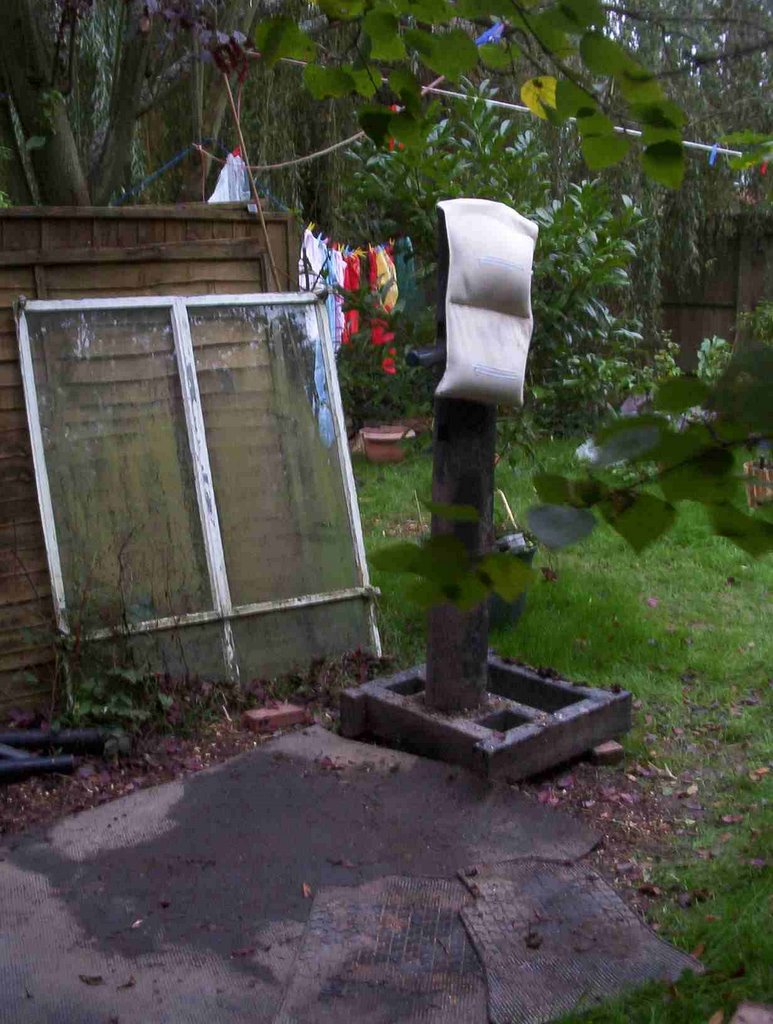
One reason why I bought my plastic Wing Chun dummy was because I have to train outside. It tends to rain outside - especially in Britain. When you train outside the ground gets churned up and the grass vanishes and is replaced by mud.
To get around this I bought a cattle mat / stable mat. This is a thick rubber mat that is about 7 x 4 foot or so. It weighs 7 stone ! I lay this down to train on and have some old car mats to place when I step off the mat. This helps to aid me train when it rains. If I didn't have this it would be a mud bath. Also I would slip all over the place.
Also I include picks of how I add in a sand bag to the dummy. I don't want to nail any bags to the dummy so hang it with plastic taping I got off a parcel. Its strong enough to take the weight of the wall bag [with just 2 sections filled]. Because I used the bag once when it was wet the normal side is splitting and leaks sand when punched so I taped that up and use this zipped side. I don't usually hit the zip so it doesn't matter.
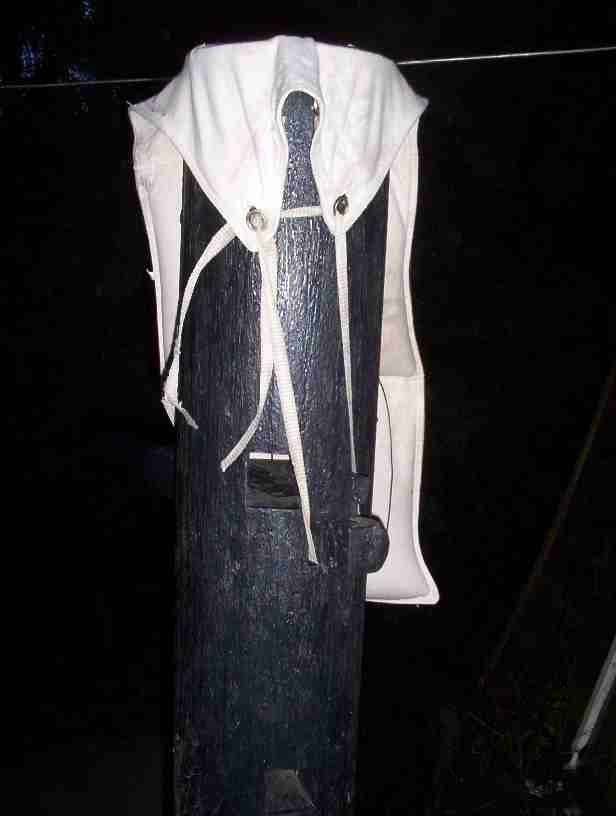
Leg and 2 arms were taken off today as I was just kicking and entering with straight blast.
Subscribe to:
Posts (Atom)