Wednesday, May 24, 2017


Tuesday, March 21, 2017
Novag Robot Adversary Chess Computer
I think there is lots of applications for robot arms.
I want one for my dummy. This one looks good. This was a commercial set in the 80s I think. It beats the other design from MB games that had magnets under the board.
Robots are 'in' now in the news. Driver-less cars gets coverage and so does potential unemployment.
What if we have robots teaching martial arts will they make Sensi redundant?
I want one for my dummy. This one looks good. This was a commercial set in the 80s I think. It beats the other design from MB games that had magnets under the board.
Robots are 'in' now in the news. Driver-less cars gets coverage and so does potential unemployment.
What if we have robots teaching martial arts will they make Sensi redundant?
Monday, February 20, 2017
freestyle on dummy
This practitioner uses some Vietnamese kung fu and main land Chinese moves he says. This and the associated video he has shows the fastest hands I have seen with hard hitting. This is not a tippy-tap' set he has here, I sense. He is kicking that wooden leg. His bones know about this, trust me. Respect.
Tuesday, January 03, 2017
Dit Da Jow: Iron hit wine in Traditional Chinese medicine
This is a well thought through analysis of this Chinese medicine.
Does Dit Da Jow Die Da Jiu really work The power of ancient kung fu me...
Here is an experiment. I am glad he massaged one side and did not just let it lie fallow at all, with no massage. I expect the next step is to do the same thing again but use a different chemical - say olive oil - on one leg to contrast vs the dit da jow.
BUT ... I have used this and I go with it.
Saturday, December 24, 2016
Monday, December 05, 2016
Kortschnoi, Grand Master - Mirror Glasses

This is a picture of Viktor Kortschnoi. He died this year
aged 85. We can learn a lot from him. He was a world class chess player who
knew the meaning of struggle.
He was a good player in the 60s but not world class until he
re-evaluated his style and changed the way he played. He then started getting
stronger and stronger. This is unusual as he got better the older he got. But
age was the reason why he got passed over for Soviet state support, as they
thought Karpov would be more likely to beat Bobby Fischer.
In 1976 Kotschnoi defected from the USSR. (He smuggled his
chess library across the boarder in 2 batches). He left his family behind and
his son was put into hard labour for 'dodging draft'.
Korschnoi did not get top level support but was able to
qualify for the 1978 World Chess Championship - beating fellow Soviets and even
playing under the Jolly Rodger flag, as he was stateless!
The picture here shows an event from the final match. Karpov's
group had KGB support and a parapsychologist staring at Kortschnoi -from the front row ..... who lost
games when this started. The mirror glasses gave some respite - as well as a group of religious gurus vibing for him to counter the parapsychologist. Kortschnoi went
5-2 down in the match. You needed 6 to win and he pulled it back to 5-5.
When I read about this match, when I took up chess and
started reading and studying. I was transfixed by these events. Korschnoi
played the same openings I did so I identified
with him. But ... he lost the final game and the match 6-5. Damm. I still read
and re=read about this match and his life. I still want him to win that final
game and I have played through these games again and again as if I was there,
or part of his team - a second - helping him with ideas and approaches.
He came back. He defeated other challengers again, in the
next World Chess Championship Cycle and qualified for the final in 1981 in
Merano. He was 50 now and past his best. He still ahd to face Karpov again, plus his entourage and KGB tricks. He played one or two great games but
lost. (These events in his life are well worth looking at in-depth for more details. The nuances are excellent to read about. Who else could cope with all the things he faced and perform).
- I want to be like Kortschnoi -
- Getting better as I get older.
- Overcoming massive barriers - State level bad tricks / efforts to unnerve me /
- Massive resilience /
- Top skills.
- A fighter.
- I WANT THOSE MIRROR GLASSES.
Thursday, November 17, 2016
One year on standing like a tree and Chi-Kung
Last year I said I would report back on my new exercise inspired by the channel 4 series from 1995 and the supporting book, on standing like a tree - Zhung Zhang.
Well despite some very, very sincere effort and real attention to detail, I had to give up after 5 months doing it. I had managed to get 30 minutes into the stance and work my way to the 2nd pose (no including the neutral start up stance).
I stand by the benefits I noted in my blog entry last year .... but there began to be a pain in my knees. I could not prevent that and I could not work out why it was being caused. I was really careful not to have knees beyond toes, and I varied the depth of the stance to make it more forgiving but the pain came back. I tried stopping the 8 pieces of brocade, to see if that was involved but no.
This was a real blow as it had good benefits on my mind. Also for the first few weeks when I started it had a real energy boost. I did not need sleep in the amounts I usually needed. The mind benefits were to make it feel calmer, anaesthetic-like, once the session got started by 10 mins in and had ended. I can get this effect from the wu chi neutral position which is something I salvaged, however.
My knees developed a creaking noise now, that was not there before. Wonder what caused that?
I did manage to keep up with the 8 pieces of brocade, however. I had stopped for 3 weeks in Spring to give knees a rest but then kept going back to it. I am glad I did this. This does give me something constant to do and come back to. The more you do it the more skilled you become, (there is a surprise). Even though the moves are simple the co-ordination of the mind / moves and breathing is not easy. In Dr Yang Ming's book he gives the supporting ideas of where the chi should be directed - I see it as mind control - and that takes some work. (He does say breathing can be just natural but he then goes on to say you can coordinate it later when you feel more confident).
The work is the beneficial thing too. I do feel more focused vs a year ago at times. Also my stretching and joints have improved in my legs. There are 2 moves, when you grab your feet, and 'shake head and tail like a bear' that give you a nice leg stretch / hip stretch. It is gentle and over the months the benefits accumulate. My hands feel warm at the end of these sessions and I tend to put them on areas of my body that feel bad and 'need healing'. Ok I cannot promise that is chi energy and the warmth is magic powers but I know my circulation is better and I do not feel the cold as much as a year ago.
Conclusion: Standing still for the 5 months showed me that simple things are not easy but there is something to be said for this. Real pity I could not keep it up. I would if I could.
Pleased I am still doing the 8 pieces, however.
So mission was partially successful.
I stopped massaging my knees in the way shown in the Tai Chi video below. I think picking up the patella and manipulating it was not a good idea. I think that is for extreme one-off pain, not a post exercise thing.
Well despite some very, very sincere effort and real attention to detail, I had to give up after 5 months doing it. I had managed to get 30 minutes into the stance and work my way to the 2nd pose (no including the neutral start up stance).
I stand by the benefits I noted in my blog entry last year .... but there began to be a pain in my knees. I could not prevent that and I could not work out why it was being caused. I was really careful not to have knees beyond toes, and I varied the depth of the stance to make it more forgiving but the pain came back. I tried stopping the 8 pieces of brocade, to see if that was involved but no.
This was a real blow as it had good benefits on my mind. Also for the first few weeks when I started it had a real energy boost. I did not need sleep in the amounts I usually needed. The mind benefits were to make it feel calmer, anaesthetic-like, once the session got started by 10 mins in and had ended. I can get this effect from the wu chi neutral position which is something I salvaged, however.
My knees developed a creaking noise now, that was not there before. Wonder what caused that?
I did manage to keep up with the 8 pieces of brocade, however. I had stopped for 3 weeks in Spring to give knees a rest but then kept going back to it. I am glad I did this. This does give me something constant to do and come back to. The more you do it the more skilled you become, (there is a surprise). Even though the moves are simple the co-ordination of the mind / moves and breathing is not easy. In Dr Yang Ming's book he gives the supporting ideas of where the chi should be directed - I see it as mind control - and that takes some work. (He does say breathing can be just natural but he then goes on to say you can coordinate it later when you feel more confident).
The work is the beneficial thing too. I do feel more focused vs a year ago at times. Also my stretching and joints have improved in my legs. There are 2 moves, when you grab your feet, and 'shake head and tail like a bear' that give you a nice leg stretch / hip stretch. It is gentle and over the months the benefits accumulate. My hands feel warm at the end of these sessions and I tend to put them on areas of my body that feel bad and 'need healing'. Ok I cannot promise that is chi energy and the warmth is magic powers but I know my circulation is better and I do not feel the cold as much as a year ago.
Conclusion: Standing still for the 5 months showed me that simple things are not easy but there is something to be said for this. Real pity I could not keep it up. I would if I could.
Pleased I am still doing the 8 pieces, however.
So mission was partially successful.
I stopped massaging my knees in the way shown in the Tai Chi video below. I think picking up the patella and manipulating it was not a good idea. I think that is for extreme one-off pain, not a post exercise thing.
Friday, October 21, 2016
Let's teach for mastery --
This video uses some analogies from martial arts teaching and progress there, to ask why do we not teach like this for schools. He raises issues of agency (learner's choosing when to progress), for instance, which is interesting.
- What do you think? Has he got a point?
- Is martial arts teaching a good metaphor in the first place?
Monday, October 17, 2016
Adult beginner violinist - 2 years progress video
This person stuck to her task and you see improvements and then a jump at 9 months especially.
She may have had other musical skills however, to ease the learning process her on this instrument but that does not take away from the achievement.
Getting away from the screechy first few months must have been the hardest, as there is a limit to how many repetitions of a simple tunes an adult can take, (I suspect).
I am not going to state the obvious and why I posted it here, other than this is typical successful adult learning. You stick to it ... you get it.
She may have had other musical skills however, to ease the learning process her on this instrument but that does not take away from the achievement.
Getting away from the screechy first few months must have been the hardest, as there is a limit to how many repetitions of a simple tunes an adult can take, (I suspect).
I am not going to state the obvious and why I posted it here, other than this is typical successful adult learning. You stick to it ... you get it.
Friday, September 30, 2016
Wing Chun Saam Sing Jong 3 Star Dummy Work Out Routine
This practitioner has some good ideas on this kicking dummy. This is not often shown in the wing chun literature. Only Randy Williams has covered this in one of his books.
(I have a sneaky suspicion that the wing chun dummy - and this - have origins as 3 legged stools and tables tied to a tree or inverted on the ground!).
(I have a sneaky suspicion that the wing chun dummy - and this - have origins as 3 legged stools and tables tied to a tree or inverted on the ground!).
Home made chi sao dummy
Here is another nice design. Again springs being used but in a different way. I like the way latteral movement is supported. This reminds me of a WW1 tank.
Chi Sao Jong Introduction Part One
This is a good design. Someone put some thought into this, indeed. He has a part 2 video as well. In that video there is a reply where someone said they bought one, did not tell their teacher, and later their teacher said they had improved. That must have been a good feeling.
You can see how the leg doubles up here to stabilse as well as be the 'jong' leg, too. I love the spring idea, too - the Choy Lee Fut dummy has that, too, so the idea is not hard to have.
I wonder if you can make an adapter for a normal dummy?
Sunday, February 28, 2016
Derren Brown Phantom Punch
I have been meaning to add this for ages to this blog. Good demo here of his skills and a good peek at a venue in China Town.
(Count how many seconds he takes to punch from 1st touch in each case).
(Derren Brown has another good trick where he plays 10 chess masters at once and does very well against them, what he does is play a move that another master has made and put that on another board, so in effect they play themselves in a circle! What you do not know however is how he gets the first move).
(Count how many seconds he takes to punch from 1st touch in each case).
(Derren Brown has another good trick where he plays 10 chess masters at once and does very well against them, what he does is play a move that another master has made and put that on another board, so in effect they play themselves in a circle! What you do not know however is how he gets the first move).
Friday, January 29, 2016
Why Exercise is good for you - we need constant reminders
This BBC page has a good animation and recent research on why exercise is good for you on multiple levels.
It has animations and a downloadable .pdf document too.
We need constant nudges to do exercise and it would help if we keep these benefits in mind too, justifying why we make the effort or convincing others of the benefit.
I like the way it suggests cognitive skills can increase after an exercise bout.
http://www.bbc.co.uk/guides/ztxng82
It has animations and a downloadable .pdf document too.
We need constant nudges to do exercise and it would help if we keep these benefits in mind too, justifying why we make the effort or convincing others of the benefit.
I like the way it suggests cognitive skills can increase after an exercise bout.
http://www.bbc.co.uk/guides/ztxng82
Monday, January 04, 2016
Pain in knees solution!
This video is excellent in many ways. One: this solution is helping my knees, that I mentioned in the post below. I did that circle knees thing and that must be the cause of my pains. The explanation of the knees being a 'hinge', not a ball and socket rotational joint says it all.
The associated video Sifu Wollering mentions states that tradition may have distorted the interpretation of the 'knee circles' from an ankle and hip rotation maybe? (The Stand Still Be Fit video has knee circles in, that is why I did it).
We need to 'oil' the knee and here the first video shows hard massage around the sides of the patella and some moving of the patella on a locked out knee. < This feels good and is helping me.
I like her videos. Her delivery is authoritative. You can see she knows what she is on about.
Sunday, December 27, 2015
Qi Gong / Chi Kung books and starting out
I have started out in Zhan Zhuang and Qi Gong (Chi Kung).

Actually I started the former - standing like a tree - in November, around 7th November to be exact.
I recall the Channel 4 program 'Stand Still Be Fit', which introduced this idea in 1994/5. I even had a go for a little while and then ditched it then, after a few days. Probably as the stance hurt. I knew nothing then.
Now with a bit of practice in stances due to forms and jurus and an interest in Chi Kung, I had re-watched the video again, from YouTube. I saw the positive comments which repeatedly said it had helped people and saw the same on Amazon reviews. So I also bought the associated book.
(One of the American reviews had said to also get Dr Yang Jwing Ming's book too, as that explains the other exercises - the 8 pieces of brocade - with more theory and details).
I have been standing 'like a tree' every day, without fail since. There are 2 poses they want you to learn properly before you 'branch out' (ahahah) into the other stances of the 'tree'. The author wants you to be able to hold the second pose for 20 minutes before you do these 'new' moves. I am trying to adhere to this exactly. In the book he advises you hold the second stance for 5 minutes for 3 weeks and the next three weeks 10 minutes etc. He said do not be in a rush to race ahead. I was a bit naughty and moved to 15 minutes, and later my knees later felt it. So I moved back to 10 minutes and modified my stance.
Now I see why he advises the 'slow road to Rome' approach. The longer you take over this the more self-knowledge you get in holding the pose, and monitoring all minor aspects of your body in the stance. While there is not much to the stance - it has no movement remember - each aspect of the post and the muscles in that need attendance to. You have to make sure your muscles are relaxed all the time and do not come unnecessarily into action vs your skeleton. You need to stop arms moving down and in. You need to monitor breathing, as abdominal breathing is preferred, if you can do that, (but not at the expense of provoking muscle tension the author notes).
It seems like ages I have been doing this, I thought I started at the beginning of November. I play meditative music too, and when you are holding out in the second stance it feels like a marathon and you start clock-watching. You have to use your mind and the beach ball metaphor to help you endure, in that your held up by the ball.
Once you can reach 20 minutes in stance two, the book says to aid you deal with the new open channels of chi coursing in your body the form of the 8 pieces of brocade will help manage this new power. That is why I also have been studying the second book. In the 'Stand Still Be Fit' video, they give the 8 pieces on the 4 day, or something and each new move throughout the 10 days. In the associated book they are far more frugal in introducing new moves.
Dr Jwing-Ming's book is very good in spelling out the ideas behind how the exercises work and what thoughts your mind needs to be focusing on for chi to be directed. NO ONE ELSE really does this explicitly, really. YouTube videos do not really focus on this and hence now I see why that US reviewer said get this book, too. < He is right. The mind needs to know what it has to do, too. I am toying with the idea of learning the 8 pieces anyway, on their own, vs waiting until being able to hold stance 2 for 20 mins, (which will be around March, late February at this rate).
[Is it any good?]
I know you have to wait for the effects to mature but I can relate to the feelings that the video and book says will occur: Tingling in fingers. This is spreading up my hands how, Started with little finger of the left hand ... then on right ... and now up the fingers yesterday. This is not my imagination.
Also from the first stance - Wu Chi - I am able to get a melting brain effect, as you switch off your mind from 'everyday' mode, to 'get ready for this exercise now' mode. My brain feels like melting butter. I later re-watched the video and the Chinese professor who they visit said that the first stage feeling is 'rain on the brain, 'brain in a shower' type feeling. < I was really glad to see this confirmed as it validated my experience and I did not imagine this. He said the next later stage of feeling is 'silent laughter'. Wow, apparently practitioners get the sensation of laughing in the body but quietly. I am no where near this, but I believe him.
I had wanted to hold off from writing about this topic until next November, when I review this and give an reasoned analysis based on experience but I could not hold off. I had a great session yesterday night when I was not clock-watching at all in the second pose but getting a great anesthetic effect. I also had tweaked my stance to avoid knees hurting and this had not affected the tingly fingers either, so I knew things were not adversely affected. < I really hope this is a pattern now for all the exercise.
One thing I can say despite the earlier aches of holding the position and monitoring yourself in a static pose etc. I have always been looking forward to do this exercise everyday. It is not like a chore as with the exercise bike I had divorced or separated from. The only thing I have to watch is my knees. Despite not going beyond toes, there is scope for lateral play in the knees despite a narrow-ish stance. (Hence my re-calibration mentioned above and the need to take this stuff slowly. I bet you can weld-in a future injury if you race ahead with poor posture / or even a posture your body shape has not modified for you enough).
On the research side of things just reading about all this, and the proposed benefits and seeking out videos, documentaries, books and articles on the web is an energy-learning-rush in itself. This goes with the territory of learning new things as an adult. I do not draw a distinction in any adult learning experience from academic study, health / martial art, chess etc. It is all the same to me: theory driven activity which has much scope for self-expression and interpretation too, which you monitor again and again.
Oh yes ... expect the problems of postures not being alike between practitioners and schools. < Always a source of worry and frustration.
Once you know the ideas behind what the moves mean and aim to do that is enough. The diversity in the 8 pieces of brocade for instance are many but it does not matter. Even the wu chi stance 1 differs between Lam Kam Chuen's own book (two stances are offered in the book, and the video only shows one type).
****UPDATE***
I am adding in the 8 pieces of brocade now, as I cannot see why that should be held back, as it is a standalone activity anyway. It will take a few weeks to remember the combination autmaticall what moves go in what order, plus the associated aims, plus thought intents.
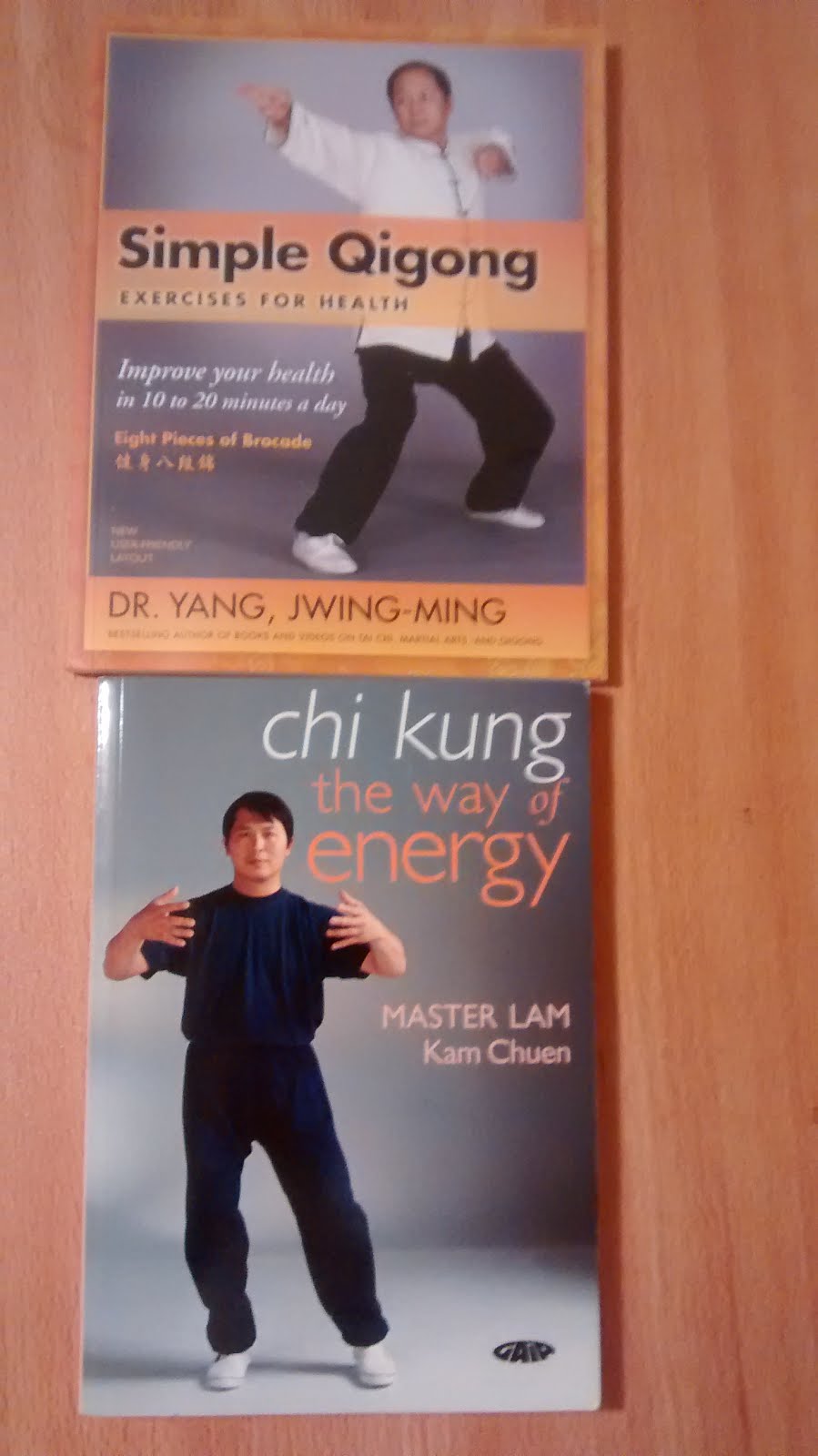
Actually I started the former - standing like a tree - in November, around 7th November to be exact.
I recall the Channel 4 program 'Stand Still Be Fit', which introduced this idea in 1994/5. I even had a go for a little while and then ditched it then, after a few days. Probably as the stance hurt. I knew nothing then.
Now with a bit of practice in stances due to forms and jurus and an interest in Chi Kung, I had re-watched the video again, from YouTube. I saw the positive comments which repeatedly said it had helped people and saw the same on Amazon reviews. So I also bought the associated book.
(One of the American reviews had said to also get Dr Yang Jwing Ming's book too, as that explains the other exercises - the 8 pieces of brocade - with more theory and details).
I have been standing 'like a tree' every day, without fail since. There are 2 poses they want you to learn properly before you 'branch out' (ahahah) into the other stances of the 'tree'. The author wants you to be able to hold the second pose for 20 minutes before you do these 'new' moves. I am trying to adhere to this exactly. In the book he advises you hold the second stance for 5 minutes for 3 weeks and the next three weeks 10 minutes etc. He said do not be in a rush to race ahead. I was a bit naughty and moved to 15 minutes, and later my knees later felt it. So I moved back to 10 minutes and modified my stance.
Now I see why he advises the 'slow road to Rome' approach. The longer you take over this the more self-knowledge you get in holding the pose, and monitoring all minor aspects of your body in the stance. While there is not much to the stance - it has no movement remember - each aspect of the post and the muscles in that need attendance to. You have to make sure your muscles are relaxed all the time and do not come unnecessarily into action vs your skeleton. You need to stop arms moving down and in. You need to monitor breathing, as abdominal breathing is preferred, if you can do that, (but not at the expense of provoking muscle tension the author notes).
It seems like ages I have been doing this, I thought I started at the beginning of November. I play meditative music too, and when you are holding out in the second stance it feels like a marathon and you start clock-watching. You have to use your mind and the beach ball metaphor to help you endure, in that your held up by the ball.
Once you can reach 20 minutes in stance two, the book says to aid you deal with the new open channels of chi coursing in your body the form of the 8 pieces of brocade will help manage this new power. That is why I also have been studying the second book. In the 'Stand Still Be Fit' video, they give the 8 pieces on the 4 day, or something and each new move throughout the 10 days. In the associated book they are far more frugal in introducing new moves.
Dr Jwing-Ming's book is very good in spelling out the ideas behind how the exercises work and what thoughts your mind needs to be focusing on for chi to be directed. NO ONE ELSE really does this explicitly, really. YouTube videos do not really focus on this and hence now I see why that US reviewer said get this book, too. < He is right. The mind needs to know what it has to do, too. I am toying with the idea of learning the 8 pieces anyway, on their own, vs waiting until being able to hold stance 2 for 20 mins, (which will be around March, late February at this rate).
[Is it any good?]
I know you have to wait for the effects to mature but I can relate to the feelings that the video and book says will occur: Tingling in fingers. This is spreading up my hands how, Started with little finger of the left hand ... then on right ... and now up the fingers yesterday. This is not my imagination.
Also from the first stance - Wu Chi - I am able to get a melting brain effect, as you switch off your mind from 'everyday' mode, to 'get ready for this exercise now' mode. My brain feels like melting butter. I later re-watched the video and the Chinese professor who they visit said that the first stage feeling is 'rain on the brain, 'brain in a shower' type feeling. < I was really glad to see this confirmed as it validated my experience and I did not imagine this. He said the next later stage of feeling is 'silent laughter'. Wow, apparently practitioners get the sensation of laughing in the body but quietly. I am no where near this, but I believe him.
I had wanted to hold off from writing about this topic until next November, when I review this and give an reasoned analysis based on experience but I could not hold off. I had a great session yesterday night when I was not clock-watching at all in the second pose but getting a great anesthetic effect. I also had tweaked my stance to avoid knees hurting and this had not affected the tingly fingers either, so I knew things were not adversely affected. < I really hope this is a pattern now for all the exercise.
One thing I can say despite the earlier aches of holding the position and monitoring yourself in a static pose etc. I have always been looking forward to do this exercise everyday. It is not like a chore as with the exercise bike I had divorced or separated from. The only thing I have to watch is my knees. Despite not going beyond toes, there is scope for lateral play in the knees despite a narrow-ish stance. (Hence my re-calibration mentioned above and the need to take this stuff slowly. I bet you can weld-in a future injury if you race ahead with poor posture / or even a posture your body shape has not modified for you enough).
On the research side of things just reading about all this, and the proposed benefits and seeking out videos, documentaries, books and articles on the web is an energy-learning-rush in itself. This goes with the territory of learning new things as an adult. I do not draw a distinction in any adult learning experience from academic study, health / martial art, chess etc. It is all the same to me: theory driven activity which has much scope for self-expression and interpretation too, which you monitor again and again.
Oh yes ... expect the problems of postures not being alike between practitioners and schools. < Always a source of worry and frustration.
Once you know the ideas behind what the moves mean and aim to do that is enough. The diversity in the 8 pieces of brocade for instance are many but it does not matter. Even the wu chi stance 1 differs between Lam Kam Chuen's own book (two stances are offered in the book, and the video only shows one type).
****UPDATE***
I am adding in the 8 pieces of brocade now, as I cannot see why that should be held back, as it is a standalone activity anyway. It will take a few weeks to remember the combination autmaticall what moves go in what order, plus the associated aims, plus thought intents.
Saturday, December 05, 2015
Wing Chun - health Massage of Hands by Steve Sinclair
https://youtu.be/mw5-sWl0MU4
https://youtu.be/4C9OARHULSA
These two videos from Steve Sinclair on hand massage in martial arts. He applies dit da jow after punching. I have his VHS somewhere, on introducing Wing Chun, which I watched 10 years ago. What impressed me was that he was the *only* person in his instructional videos to tackle the issue of caring for yourself.
I cannot find his original video, but the way he insists on taking care of your hands how punching a wall bag is a "serious abuse of your joints" really stuck in my mind. It is true. It is self-harm, in a way isn't it.
I bought some dit da jow and apply it to bruises and knuckles in the vigorous way he mentions. He rotates in a small circle and takes off the top layer of skin. The rubbing gets the blood to the damaged area and aids repair. I see here in this video he argues a partner can be more effective, but you can imagine what a solo style of massage looks like.
You can find 'how to' videos on making your own dit da jow and when I researched it, it can get very technical, with many dos / don'ts and very fine attention to detail about herbs etc. I bought mine off a Karate teacher and it seems ok. Smells like Chinese herbs in alcohol :>
https://youtu.be/4C9OARHULSA
These two videos from Steve Sinclair on hand massage in martial arts. He applies dit da jow after punching. I have his VHS somewhere, on introducing Wing Chun, which I watched 10 years ago. What impressed me was that he was the *only* person in his instructional videos to tackle the issue of caring for yourself.
I cannot find his original video, but the way he insists on taking care of your hands how punching a wall bag is a "serious abuse of your joints" really stuck in my mind. It is true. It is self-harm, in a way isn't it.
I bought some dit da jow and apply it to bruises and knuckles in the vigorous way he mentions. He rotates in a small circle and takes off the top layer of skin. The rubbing gets the blood to the damaged area and aids repair. I see here in this video he argues a partner can be more effective, but you can imagine what a solo style of massage looks like.
You can find 'how to' videos on making your own dit da jow and when I researched it, it can get very technical, with many dos / don'ts and very fine attention to detail about herbs etc. I bought mine off a Karate teacher and it seems ok. Smells like Chinese herbs in alcohol :>
Saturday, November 14, 2015
Learning to make progress
This next BBC link is very useful as it shows how progress is product of 'eeeking' ... gradual trial and error to achieve the next level of excellence.
"Dyson worked his way through 5,126 failed prototypes before coming up with a design that ultimately transformed household cleaning", (BBC Viewpoint 2015). < This quote sums up a lot really and gives us a realistic view of what progress is about.
The sudden insight of genius idea does not help us, I think.
Full link here
http://www.bbc.co.uk/news/magazine-34775411
This can be applied to any adult learning scenario and I wont try and 'adapt' this to the theme of my blog, as it should talk for itself. Just do not be afraid to make mistakes and await that perfect solution to come and hit us on the head, like Newton's apple .. it comes with thousands of reps. See the 10,000 hours ideas too below.
"Dyson worked his way through 5,126 failed prototypes before coming up with a design that ultimately transformed household cleaning", (BBC Viewpoint 2015). < This quote sums up a lot really and gives us a realistic view of what progress is about.
The sudden insight of genius idea does not help us, I think.
Full link here
http://www.bbc.co.uk/news/magazine-34775411
This can be applied to any adult learning scenario and I wont try and 'adapt' this to the theme of my blog, as it should talk for itself. Just do not be afraid to make mistakes and await that perfect solution to come and hit us on the head, like Newton's apple .. it comes with thousands of reps. See the 10,000 hours ideas too below.
Saturday, July 18, 2015
Passion - it is a real concept in sports psychology
Coming back from class, in a conversation about learning, my friend David used the word 'passion'. This was ironic, as the day before I had read about this in my textbook on sports psychology and was surprised to see this was a 'real' concept of study, not just an everyday language term.
The issue of internalisation means the activity defines us and is part of our identity (i.e. who am I and how I see myself). The activity is integrated into ourselves. You may be committed to learning piano or violin or bringing up someone else's step-child and be motivated to do this for the benefits of just doing that ... but it is not a problem if you stop in terms of emotional costs, as these are not self-defining activities. (You get the idea .. make up your own example here).
There are two types of Passion: Obsessive Passion vs Harmonious Passion.
The former has an aspect of compulsion to engage with the activity, as if the participant is controlled by the activity and there is emotional dependency. (I think the book was making a distinction between this and addiction, however).
The latter - harmonious passion, has an aspect of choice in it and the activity fits in with other commitments and does not disrupt them dysfunctionally.
As with many concepts in psychology, there is a scale to measure this ...'The Passion Scale' (Vallerand et al 2003, cited in ibid,p.254).
The Passion Scale
Harmonious Passion
1, My activity allows me to live a variety of experiences
2. The new things that I discover within the confines of my activity allow me to appreciate it even more
3. My activity activity reflects the qualities I like about myself
4. My activity is in harmony with other actives in my life
5. My activity is a passion that I am still manage to control
6, My activity allows me to live memorable experiences
7. I am completely taken with my activity
Obsessive Passion
8. I cannot live without my activity
9. The urge is so strong. I cannot help myself doing the activity
10, I have difficulty imagining my life without my activity
11. I am emotionally dependent on my activity
12 I have a tough time controlling my need to do my activity
13 I have an almost obsessive feeling to my activity
14 My mood depends on me being able to do my activity
Where are you on this scale?
Is this scale of use deciding who is worth spending energy on if you had to choose between prospective students, or prospective activities?
Is this scale useful in moderating commitments and preserving a participants life-cycle in the activity?
Is the scale valid? Can you measure 'passion' like it was temperature? Does it really exist as a 'thing' in reality?
(I have yet to study the whole chapter .. I may type up some more later). This should make us think however...
:
One definition was "passions are defined as high-priority goals with emotionally important outcomes" (Frijda et al. 1991 cited in Jowett and Lavelle 2007,p.250).Passion is not the same as commitment or motivation per se. They can overlap but the difference is the issue of internalisation.
The issue of internalisation means the activity defines us and is part of our identity (i.e. who am I and how I see myself). The activity is integrated into ourselves. You may be committed to learning piano or violin or bringing up someone else's step-child and be motivated to do this for the benefits of just doing that ... but it is not a problem if you stop in terms of emotional costs, as these are not self-defining activities. (You get the idea .. make up your own example here).
There are two types of Passion: Obsessive Passion vs Harmonious Passion.
The former has an aspect of compulsion to engage with the activity, as if the participant is controlled by the activity and there is emotional dependency. (I think the book was making a distinction between this and addiction, however).
The latter - harmonious passion, has an aspect of choice in it and the activity fits in with other commitments and does not disrupt them dysfunctionally.
As with many concepts in psychology, there is a scale to measure this ...'The Passion Scale' (Vallerand et al 2003, cited in ibid,p.254).
The Passion Scale
Harmonious Passion
1, My activity allows me to live a variety of experiences
2. The new things that I discover within the confines of my activity allow me to appreciate it even more
3. My activity activity reflects the qualities I like about myself
4. My activity is in harmony with other actives in my life
5. My activity is a passion that I am still manage to control
6, My activity allows me to live memorable experiences
7. I am completely taken with my activity
Obsessive Passion
8. I cannot live without my activity
9. The urge is so strong. I cannot help myself doing the activity
10, I have difficulty imagining my life without my activity
11. I am emotionally dependent on my activity
12 I have a tough time controlling my need to do my activity
13 I have an almost obsessive feeling to my activity
14 My mood depends on me being able to do my activity
Where are you on this scale?
Is this scale of use deciding who is worth spending energy on if you had to choose between prospective students, or prospective activities?
Is this scale useful in moderating commitments and preserving a participants life-cycle in the activity?
Is the scale valid? Can you measure 'passion' like it was temperature? Does it really exist as a 'thing' in reality?
(I have yet to study the whole chapter .. I may type up some more later). This should make us think however...
:
Subscribe to:
Posts (Atom)