In this scene between the King and his speech therapist a good point is raised. Can you teach and be credible without formal qualifications?
The therapist, Lionel does not have any formal qualifications it turns out and his credibility is questioned.
The response is strong - 'look at my results from my experiences in therapy they are my credentials'.
In martial arts having a formal qualification is designed to show you can 'do' and have studied. This is designed to prevent abuse and fraud. The other side of this is, if you do not have not passed over these hurdles you can exclude gifted people. Also, the qualification can be an excuse to charge big money for that certificate, it can be like an industry in its own right.
The motive was not money here. In the final scenes you see the issue is friendship at the core here. Not having any then finding a friend, through the therapy. The therapist was a guide here leading the future King away from his fears as a 5 year old when he developed his stammer. It was the fear of developing that was the key. They physical method of change they called 'mechanical' issues in this film, were seen as secondary: breath techniques, etc.
This is a good film as it has transformation of the self at the core, with genuine contact with others..
Wednesday, April 16, 2014


Sunday, February 23, 2014
Mysteries & Their Solving
This is the Mystery Machine:
 When doing adult learning, (where you are there by choice), the discipline you are in for a novice often presents itself with fun-puzzles.
I was thinking about this in relation to some moves Slippers showed me once. The moves are new and they look mysterious - a knife disarm ... but could be a guard pass, or block, or defence to kicks .. anything ...Working down this typology you can see the mystery unravel and be less ... mysterious .... you break it down even more - the synthesis gets involved when you locate the new mystery move in relation to familiar moves you know.Then you evaluate and weigh up this new strange move. (It probably is still 'a mystery', as a sensory motor skill takes ages to hone and 'own' in order to 'apply' usefully.
But the point is the sense of mystery is the key to keeping going. There are loads of mysteries in adult learning asking to be solved. I wonder if you could amend Blooms typology to fit with the mentalities of the Scooby Do crew.


- How did they do that?
- I watched X do this but still can work that out?
- How do you do this ... I have attempted this 100s of times but still cannot - it must be magic!
The skills involved look like they are magic as they transform one state into another state.
If you do not know the mechanics of this then the mystery creates awe and arousal - which can be addictive parts to adult learning.
Even once tasks are broken down and shown, adopting the skills are hard.
This is how a learning - as mystery typology looks, (source http://www.mysterynet.com/learn/why/ : accessed Feb 2014)
All Stages of Bloom's Taxonomy
As presented in Bloom's Taxonomy, mysteries can be used to achieve higher levels of thinking in these ways:
- Knowledge: Students arrange characters and events in the mystery.
- Comprehension: Students classify events, describe characters, and explain precisely what has occurred.
- Application: Students apply existing knowledge to the mystery by illustrating, dramatizing, and writing their interpretations.
- Analysis: Students analyze, categorize, and differentiate characters and events.
- Synthesis: Students collect and organize facts to form hypotheses.
- Evaluation: Students appraise, argue, assess, and evaluate their opinions in the process of solving the mystery.
------
But the point is the sense of mystery is the key to keeping going. There are loads of mysteries in adult learning asking to be solved. I wonder if you could amend Blooms typology to fit with the mentalities of the Scooby Do crew.
- Are you like Fred ?
Fred is adventurous and pro-active and tries to take immediate proactive solutions to mysteries.
- Are you like Velma?
Velma is very cerebral and thinks and reflects on how to solve mysteries. She takes her time and is not the most physical of people, but wont be put off because of that. Even though she is short sighted and loses her glasses - her other senses compensate for that. Many roads lead to the solving of a mystery. Notice how she often gets separated from Fred and Daphne in the solution of a mystery. Some types collaborate better with others for mystery solving.
- Jyyyyikes ... Are you like Shaggy and Scooby?
These two are risk averse.
These two would be the last to pick up an injury in training as they take care of themselves too much. (But that is not a bad thing, but some sense of adventure would not be harmful, always).
When they solve a mystery it is by being in the right place place in (their) wrong time, via serendipity.
These two are not in the business to solve mysteries, they want to fill their stomachs really. Their motivation is not really pro-mystery solving.
[NB no Scrappy-do here, as I don't think he should have been created. He does not add that much to the mix].
Thursday, December 19, 2013
My training poem ..
I wrote this poem to reflect some thinking I am going through ...
Learning and unlearning
Learning and unlearning
New technique ... if I learn you, you will make me look
rather chic
But you are hard to grasp
and if I try and rush it the outcome is in fact .. bleak.
I look poor at first mimicking your moves
it looks like I have
donkey hooves!
When it comes to mastering you I show it off to all concerned...
Then get told to re-learn it all from scratch as it is all
wrong in the first place.
Dam! This is typical in the martial arts
It makes you feel like there is no light at the end of the
tunnel - except just another train.
I start again from scratch,
these moves I rehash and patch
Now I know how Incey-Wincey spider felt being flushed down
the drain
New Technique II you are the sequel
And if I can master these you make me look like the others
and now an equal
William Blake.
Wednesday, October 30, 2013
Dracula : Father of Modern Kung Fu
Here is Bela Lugosi as Dracula.
I am convinced he was the teacher of other future Kung Fu stars:
The top picture is a classic pose.


 Underneath you can see his understudy summoning up supernatural powers too.


 Here we see a modified crane move that his understudy develops decades later - below ...


 Here we see the traditional old school had not approved the use of weapons. (Note the tiger claw).
Below we see tools being OK even for understudies!
I am convinced he was the teacher of other future Kung Fu stars:
The top picture is a classic pose.


 Here we see the traditional old school had not approved the use of weapons. (Note the tiger claw).
Below we see tools being OK even for understudies!
Friday, September 20, 2013
Come correctly a-tyred you dummy!
Excuse the pun but it had to be inserted!
In addition to experimenting with inner-tubes I put a wheelbarrow tyre and inner-tube combination on the dummy, too.
In the pictures you can see different set-ups of the spacing of the wheels.

 The wheels can be punched hard. How hard depends on the inflation level of the inner-tube. There is a trade-off between 'squish' of an impact and bounce-back . If you want to go 100% all out on this good luck to you, as you need to work out the sweet spot on the wheel, (as it rounded). Also, even when inflated normally a rear cross, or knee, will find a connection to the core of the dummy. You could I think work out a way to counter this with a bit of experimentation with inflation levels..
In addition to experimenting with inner-tubes I put a wheelbarrow tyre and inner-tube combination on the dummy, too.
In the pictures you can see different set-ups of the spacing of the wheels.

 The wheels can be punched hard. How hard depends on the inflation level of the inner-tube. There is a trade-off between 'squish' of an impact and bounce-back . If you want to go 100% all out on this good luck to you, as you need to work out the sweet spot on the wheel, (as it rounded). Also, even when inflated normally a rear cross, or knee, will find a connection to the core of the dummy. You could I think work out a way to counter this with a bit of experimentation with inflation levels..
There is a nice bounce-back from the recoil on the kicks and knees.
You need gloves to punch the rubber as your skin will be taken off by the friction. I had MMA gloves on which also had my middle knuckle covered too, which was very welcome as that too would pick up some skin-scraping.
Conclusion: This beats traditional dummy pads. This would take sticks too and cut out the noise.
It is harder to manoeuvre the wheels into place as the inner-tube creates friction. Your joints will thank you for this over time.
Thursday, August 22, 2013
The Medium is the Message!
You do not have to have a teak wooden dummy to do dummy moves. Any medium can work. It is the angles that matter. The dummy is often said to be a protractor - i.e. it encourages you to move and face certain angles and not others.
The arms are open to different media. Here are a selection of pics of the types of materials I use on my dummy.
 [Example 1 out of 6]
First pic is of some arms I picked up recently with glossy wooden arms. These are lovely to work with and are now my first choice. They make a lovely clacking noise, very crisp. And the wood is slightly lighter than my other beechwood arms, which creates a different feel. The offset nature of the back end of the arm is more pronounced, too.
[Example 2]
 I even used my new nunchuks in there to be a de facto arm. The stubby nature is what can be expected but the rubbery nature of the 'arm' is interesting. Gum & Bong sau is possible in this low down position, at least.
(NB yes - if you are wondering you can strike the dummy with the heavy rubber nunchaku. It does not make marks, as far as I can see that are deep or permanent. The recoil is the worst enemy. Use 'witik' strikes then if you are not certain of what the recoil will be like).
 < A silencer! If you are up in the very early morning, or late at night and do not want those clacking noises then the rubbery edge connectors of those child play mats can be slotted in.
These 'give' a little when pressed and offer a different feeling.
 Should have thought of this years ago. A pick axe handle offers something new. Distance.
(Some people think this is heresy, as you are fooling with tradition. I say Bruce Lee led the way - and that happened any way when the Pole was added to the Wing Chun inventory).
 The reverse side shows the flared ending being of use too.
 < 'A' for effort. The wheelbarrow inner-tube was a good try but you cannot expect to use this for heavy punches. The air just gives way to the force and moves elsewhere. If you were to pump this up to take the force then the tube would be bloated to exploding point, I bet ?!


The arms are open to different media. Here are a selection of pics of the types of materials I use on my dummy.

First pic is of some arms I picked up recently with glossy wooden arms. These are lovely to work with and are now my first choice. They make a lovely clacking noise, very crisp. And the wood is slightly lighter than my other beechwood arms, which creates a different feel. The offset nature of the back end of the arm is more pronounced, too.
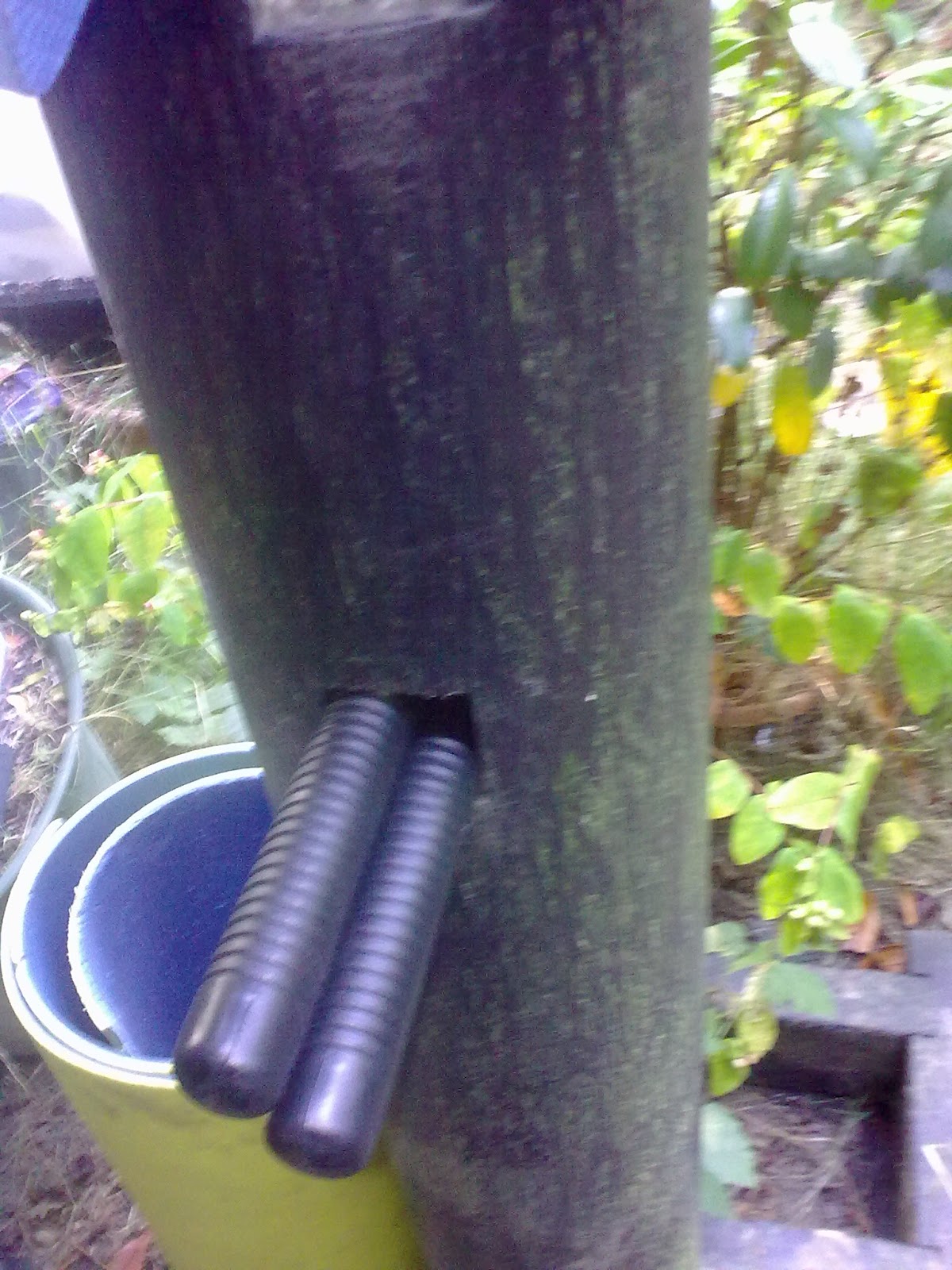 I even used my new nunchuks in there to be a de facto arm. The stubby nature is what can be expected but the rubbery nature of the 'arm' is interesting. Gum & Bong sau is possible in this low down position, at least.
These 'give' a little when pressed and offer a different feeling.

(Some people think this is heresy, as you are fooling with tradition. I say Bruce Lee led the way - and that happened any way when the Pole was added to the Wing Chun inventory).
 The reverse side shows the flared ending being of use too.
 < 'A' for effort. The wheelbarrow inner-tube was a good try but you cannot expect to use this for heavy punches. The air just gives way to the force and moves elsewhere. If you were to pump this up to take the force then the tube would be bloated to exploding point, I bet ?!
This picture shows a yoga mat plus inner tube. It is different. Now the softer inner tube adds something to the mat alone. The tube also stops the mat unravelling, as I have not cut squares into it like the YouTube suggestion below.

I suspect sharper readers of this blog will see an uncanny resemblance to the Emperor Dalek below from Dr.Who. ;>

Saturday, August 10, 2013
These are my training partners.
It is right to give praise to your training partners.
Here are mine.
They know who they are.
A pop star. A chess world champion ... and some slippers.


Monday, July 08, 2013
Mook Yan Jong (Wooden Dummy) Padding under $20
Home made padding for Wooden Dummy
This person has an excellent idea for bespoke padding for the dummy. This idea of wrapping a yoga mat around the body and few times, taping it and then cutting an 'X' shape in the arm squares is clever.
- This idea means you are not just restricted to the high and low areas, where traditional pads are inserted. You have access to mid-range, and even behind - should that be relevant. Maybe even weak knee strikes could be used.
- He mentions the give in the arms are affected as the mat adds distance, now, so maybe the peg is redundant. (Just don't lap sau in a straight line then, pull down with the lap sau to avoid it pulling out !?).
Home made padding for Wooden Dummy
This person has an excellent idea for bespoke padding for the dummy. This idea of wrapping a yoga mat around the body and few times, taping it and then cutting an 'X' shape in the arm squares is cleaver.
- This idea means you are not just restricted to the high and low areas, where traditional pads are inserted. You have access to mid-range, and even behind - should that be relevant. Maybe even weak knee strikes could be used.
- He mentions the give in the arms are affected as the mat adds distance, now, so maybe the peg is redundant. (Just don't lap sau in a straight line then, pull down with the lap sau to avoid it pulling out !?).
Monday, May 27, 2013
Automated reaction / punch simulator
This person has really thought about this device. I really think this idea is worth perusing. The foot pedal idea adds an uncertainty to the release of the strike that makes the reaction less predictable.
I wonder what his ideas are for curved 'hook' angles!
Note he has an adjustable height for kicks.
Slippers build this for me.
Saturday, May 18, 2013
Why Chess is like Martial Arts II
Here is another aspect to chess culture that is like martial arts. The evaluative side. 'Which is the best system' debate. These often crop up.
This debate is similar to chess :
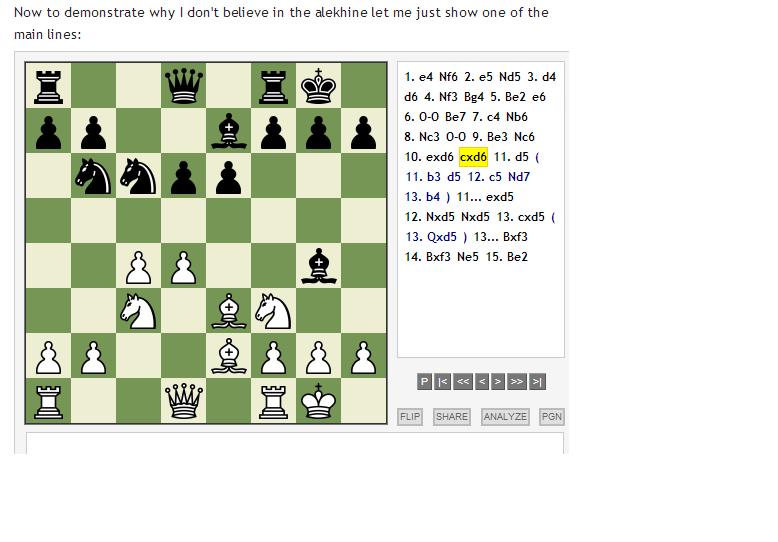
I play this line called the Alekhine Defence. It lets white chase black's knight to the edge to create an asymmetric unbalanced position.
 On another forum someone commented on the same system:
'Playing the Alekhine is like driving a Ferrari without the speed. You're doing way more work than the others and you aren't really doing much better with it. It's tricky in that you put yourself in awkward situations to imbalance things. Anyway I'm sure anyone under master can use it. The real question is whether it's even worth it...'.
----
This type of insight hurts, as you put investment into this and it could be in vain. Is the solution to try harder and make these positions work for you. In other-words play from these sub-optimal positions as Black and work it .... work it .... work it .... until you are expert?
Or just find positions that are equal in the first place, and then work from that platform, via an orthodox chess defence in the first place. (I do admit to being drawn to Petrov's Defence).
Yet at armature level reading the board is hard. I played white today vs Alekhine's Defence and still I came unstuck - AND I know this system as Black! The shapes are not normal and keeping tabs on the ideal placement of pieces chasing the theoretical advantage in an irrational context of a time-pressured game is not easy. This has happened a few times. I want to avoid the system I know which is 'bad', as I cannot cope with it ?!
At the moment the best PR in the martial art world goes to cage fighting systems. See the Straightblast Gym and Matt Thornton for the 'delivery systems' that draw upon Thai boxing and Brazilian ju-Jitsu for these. Anything else is seen as probably less reliable, according to this orthodoxy. 'Look to the results' in professional fights, is the basis of this debate.
This debate is similar to chess :
I play this line called the Alekhine Defence. It lets white chase black's knight to the edge to create an asymmetric unbalanced position.
'Playing the Alekhine is like driving a Ferrari without the speed. You're doing way more work than the others and you aren't really doing much better with it. It's tricky in that you put yourself in awkward situations to imbalance things. Anyway I'm sure anyone under master can use it. The real question is whether it's even worth it...'.
----
This type of insight hurts, as you put investment into this and it could be in vain. Is the solution to try harder and make these positions work for you. In other-words play from these sub-optimal positions as Black and work it .... work it .... work it .... until you are expert?
Or just find positions that are equal in the first place, and then work from that platform, via an orthodox chess defence in the first place. (I do admit to being drawn to Petrov's Defence).
Yet at armature level reading the board is hard. I played white today vs Alekhine's Defence and still I came unstuck - AND I know this system as Black! The shapes are not normal and keeping tabs on the ideal placement of pieces chasing the theoretical advantage in an irrational context of a time-pressured game is not easy. This has happened a few times. I want to avoid the system I know which is 'bad', as I cannot cope with it ?!
Friday, May 03, 2013
What is the point : ? 'Searching for Bobby Fischer' Master Certificate (1993)
This clip has many meanings. For me it shows why chess sub-culture can relate to other cultures that involve learning 'apprenticeships'.
The novice wants validation of progress. What is 'progress' is the knowledge ... but something physical is needed to demonstrate that - a 'token'. Here a young Josh Waitskin, when he was a chess prodigy, like many children I suspect wants a certificate to boost his self-esteem and show 'progress'.
The mentor played by Ben Kingsley is trying to show that the token of progress is not the goal ...
This trap to fall into is easy at martial art level. In Josh's book, The Art of Learning, he has an epiphany and later decides chess is not for him and becomes a Tai Chi master. During his 'journey' there, he notices people who become 'form collectors' , people who pick up sequences of moves, for its own sake, rather than the understanding and the slow graft to understand these moves authentically. Belts can do this, too. The desire for belts to show progress can represent tokenism, where the belt becomes the object of desire not the understanding and the graft and the intrinsic merits of the activity. (This relates to process vs outcome orientated goals - in a post I made below, a couple of years ago).
Moving learners to become appreciate of process goals, rather than outcome related goals, can increase their adherence to a tasks, should set-backs occur. They become resilient.
Here in this clip, the trainer - is expelled from the house but he tries to justify his reasons to both Josh and his Mother. He has a point. The McDonaldisation idea of him reproducing the standardised certificates does link to a McDojo, type feel, of the 'token' being meaningless ultimately. The way he dishes out the certificates is like a photocopier, or a machine stamping out beef burgers. There is no craft behind the certificate that way.
Josh does not know that, however, as he is too young to be able to have any experience to judge progress. This applies to any learner, who is new to a craft. How do you know you have made progress, if you cannot judge for yourself, as you are not experienced to judge for yourself? This sea of doubt goes with any learning territory like chess martial arts, starting out on a degree etc. You have to ride it out and over time changes occur, that become visible to yourself. You do things, think new ideas for yourself without being shown. < This for me is an example of validation.
Thursday, February 14, 2013
Making the Low Cost but Effective Wing Chun Dummy MK.II Video - Khai Tuo...
This is an excellent revision to the previous video below. Some good thinking in here, which deserves merit. Thanks for sharing this!
Sunday, December 30, 2012
wingchunoctopus
This is a really good video as it shows some innovative thinking about the Wing Chun dummy.
There are some arms added, which makes the practitioner re-consider footwork patterns.
Randy Williams talks about the 'V' shape footwork and how the 2 extra arms affect the drills / partner relationship.
Also, what I liked is that he kneels down to use the dummy. I have not seen anyone else do that before, as it makes you think about height-levels in a new way.
Some of the comments to the video think the extra arms could teach bad habits as you could be tempted to reach to the extra set of arms rather than step to them or pivot into them ?!
I think this is a good idea.
Thursday, October 25, 2012
Autumn Dummy 2012
In keeping with the odd seasonal picture .... I took this.
The red tree had shed some Autumn leaves and it looked like a red carpet. I went in to get my camera. There will be a cold snap soon, so the leaves will fall off, shortly.
We did some triangle footwork in training the other day, and I nearly posted a picture of an apple turnover to signify the 'V' shape but thought better of it. (You cannot dispute the loveliness of apple turnovers, however).

The red tree had shed some Autumn leaves and it looked like a red carpet. I went in to get my camera. There will be a cold snap soon, so the leaves will fall off, shortly.
We did some triangle footwork in training the other day, and I nearly posted a picture of an apple turnover to signify the 'V' shape but thought better of it. (You cannot dispute the loveliness of apple turnovers, however).

Thursday, October 11, 2012
Innovation - look at other sports
This link here shows insights from Neville Southall, Everton's goalkeeper in the 80s and 90s. He was a well respected keeper and thought of as best in the world, for a time, in the 80s.
He talks about how he sought to improve, using alternative ideas.
For example:
He talks about how he sought to improve, using alternative ideas.
For example:
- Dressing in black to make himself look larger
- Wearing the cheapest plastic boots, rather than the sponsor's top range shoes
- Getting to the ground earlier than everyone, to familiarise with the surroundings
In this account he states even a 100 changes to make a 1% improvement is worth it, at elite level.
One memorable game I can remember, is the second[half of the 1995 FA Cup final, Everton vs Man Utd.
Man U, threw everything at Southall in goal, to get back into the game and Southall did everything to stop that!
Thursday, June 07, 2012
Making the Low Cost but Effective Wing Chun Dummy By Khang Tuong Nguyen
This seems like a viable design for a wooden dummy. I like the way the body can be moved up and down the post for variable height. That is very useful. Notice in the video where his Dad, got the idea from for the body - Sushi rolling mat-thingy.
The arms come from a table leg - that is interesting. The design they have for the legs could be simpler, as it has groves in but that is not inevitable.
I would like to see him use this, to see what type of force it can take. I like to see what they would consider doing about a leg for it.
Thursday, May 24, 2012
Skipping like a girl?
I wish I could skip like this girl! I bought a skipping rope a few weeks ago and went to use it now the weather is warm and I can go outside where there is space to skip.
- First thing. I cannot skip!
- Second thing. It does test your co-ordination. This video did say that.
- I had to set myself a realistic goal, therefore, to adhere to the task.
- For me just getting the rope to go over my head without mangling up on my body was that goal. (I did manage one skip however, a few times) But I called it a day, as that was enough.
- Today, I managed 5 skips, before it got mangled up. I could feel myself getting all light headed when a pattern started and as soon as I was conscious of that .... rope gets mangled.
- My next goals will be to build up the number of skips and then once I am automated in that , learn some other skipping footwork.
Sunday, May 06, 2012
Pushing Body & Mind: Richard Gomm Making the Most of the Micro Jan 1983
This video is very inspiring because it shows someone pushing their body and mind. The two are linked.
Richard was studying for a PhD at the time of this program shown late at night on Mondays on BBC1. (Look at his book shelf, when the camera scans it).
The program was called 'Making the Most of the Micro'. This person is probably one of few who really had learned to program and use their computers for productive purposes, too. He says he had to teach himself to create new programs to help him. (The signature he creates, is made of full stops joined together - very cleaver - and adds a personal level to the communications he makes).
He passed his PhD and there is a book about his life, written by his Mother. I want to get that.
Tuesday, February 28, 2012
Excercise .. a re-think!
Exercise ..... mmmmm.... a hard cardio work-out I mean ... I love to exercise -- the burning lungs ... the sweat ... the feeling you are going to collapse .......yuk yuk yuk, don't be silly.
I see the cardio side, as a chore a lot of the time. The dull repetitive tasks are not far off working on an assembly line. And like the latter you only do it for the outcomes - the benefits being health related.
Ways around the repetitive nature of exercise in martial arts, can be to do moves and drills that also look like the moves you do in your art and there is overlap. < This is what I do now, with my mini-weights.
But to do these moves burns up the energy store you have. In training with my colleges Slippers and Sleeve, you can see after a 3 minute round the effects hitting a pad has on you. Pufff, pufff puff. (Sometimes the sensation to vomit). This is why cardioid-exercise is a necessary evil for self-defence. No engine, no gas ... can't run off even!
This web page on the BBC and the supporting Horizon program, really fascinated me. It shows how individual differences in people will affect the responsiveness we have to exercise regimes. Blanket advice is 'exercise is good for you'. The implications of the program are - types of exercise need tailoring to types of people whose genetic makeup makes them responsive to some types of exercise, not others.
http://www.bbc.co.uk/news/health-17177251
and
http://www.bbc.co.uk/programmes/b01cywtq
(If you are outside the UK in theory you cannot see the program - but there are ways).
What interested me is the short intensive exercise of 3 x 20 second all-out bursts on a bike..... And that is it! I had been told about tabata exercise before - is this that ? Look at the evidence for the benefits given. See also what did not change.
I will explore the related academic paper soon:
http://www.springerlink.com/content/h774562781l24jq0/
I see the cardio side, as a chore a lot of the time. The dull repetitive tasks are not far off working on an assembly line. And like the latter you only do it for the outcomes - the benefits being health related.
Ways around the repetitive nature of exercise in martial arts, can be to do moves and drills that also look like the moves you do in your art and there is overlap. < This is what I do now, with my mini-weights.
But to do these moves burns up the energy store you have. In training with my colleges Slippers and Sleeve, you can see after a 3 minute round the effects hitting a pad has on you. Pufff, pufff puff. (Sometimes the sensation to vomit). This is why cardioid-exercise is a necessary evil for self-defence. No engine, no gas ... can't run off even!
This web page on the BBC and the supporting Horizon program, really fascinated me. It shows how individual differences in people will affect the responsiveness we have to exercise regimes. Blanket advice is 'exercise is good for you'. The implications of the program are - types of exercise need tailoring to types of people whose genetic makeup makes them responsive to some types of exercise, not others.
http://www.bbc.co.uk/news/health-17177251
and
http://www.bbc.co.uk/programmes/b01cywtq
(If you are outside the UK in theory you cannot see the program - but there are ways).
What interested me is the short intensive exercise of 3 x 20 second all-out bursts on a bike..... And that is it! I had been told about tabata exercise before - is this that ? Look at the evidence for the benefits given. See also what did not change.
I will explore the related academic paper soon:
http://www.springerlink.com/content/h774562781l24jq0/
Subscribe to:
Posts (Atom)