Thursday, August 22, 2013

The Medium is the Message!

You do not have to have a teak wooden dummy to do dummy moves. Any medium can work. It is the angles that matter. The dummy is often said to be a protractor - i.e. it encourages you to move and face certain angles and not others.

The arms are open to different media. Here are a selection of pics of the types of materials I use on my dummy.


[Example 1 out of 6]


First pic is of some arms I picked up recently with glossy wooden arms. These are lovely to work with and are now my first choice. They make a lovely clacking noise, very crisp. And the wood is slightly lighter than my other beechwood arms, which creates a different feel. The offset nature of the back end of the arm is more pronounced, too.
[Example 2]
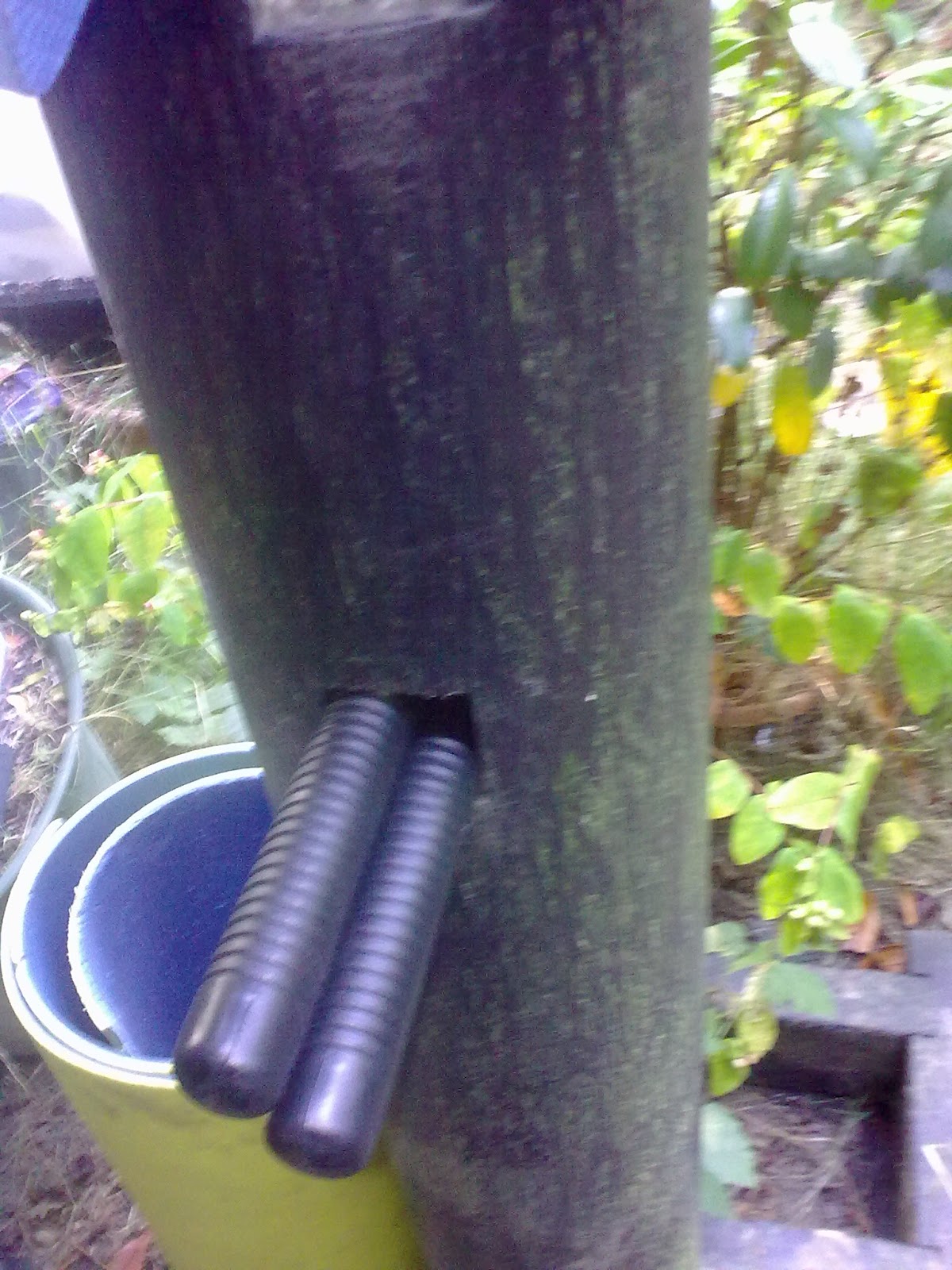
I even used my new nunchuks in there to be a de facto arm. The stubby nature is what can be expected but the rubbery nature of the 'arm' is interesting. Gum & Bong  sau is possible in this low down position, at least.

(NB yes - if you are wondering you can strike the dummy with the heavy rubber nunchaku. It does not make marks, as far as I can see that are deep or permanent. The recoil is the worst enemy. Use 'witik' strikes then if you are not certain of what the recoil will be like).

< A silencer! If you are up in the very early morning, or late at night and do not want those clacking noises then the rubbery edge connectors of those child play mats can be slotted in.
These 'give' a little when pressed and offer a different feeling.
Should have thought of this years ago. A pick axe handle offers something new. Distance.

(Some people think this is heresy, as you are fooling with tradition. I say Bruce Lee led the way - and that happened any way when the Pole was added to the Wing Chun inventory).
The reverse side shows the flared ending being of use too.

< 'A' for effort. The wheelbarrow inner-tube was a good try but you cannot expect to use this for heavy punches. The air just gives way to the force and moves elsewhere. If you were to pump this up to take the force then the tube would be bloated to exploding point, I bet ?!


This picture shows a yoga mat plus inner tube. It is different. Now the softer inner tube adds something to the mat alone. The tube also stops the mat unravelling, as I have not cut squares into it like the YouTube suggestion below.


I suspect sharper readers of this blog will see an uncanny resemblance to the Emperor Dalek below from Dr.Who. ;>


Saturday, August 10, 2013

These are my training partners.


It is right to give praise to your training partners.
Here are mine.

They know who they are.
A pop star. A chess world champion ... and some slippers.


Monday, July 08, 2013

Mook Yan Jong (Wooden Dummy) Padding under $20


Home made padding for Wooden Dummy


This person has an excellent idea for  bespoke padding for the dummy. This  idea of  wrapping a yoga mat around the  body and few times, taping it and then cutting an 'X' shape in the arm squares is clever. 
  • This idea means you are not just restricted to the high and low areas, where traditional pads are inserted. You have access to mid-range, and even behind - should that be relevant. Maybe even weak knee strikes could be used.
  • He mentions the give in the arms are affected as the mat adds distance, now, so maybe the peg is redundant. (Just don't lap sau in a straight line then, pull down with the lap sau to avoid it pulling out !?).

Home made padding for Wooden Dummy


This person has an excellent idea for  bespoke padding for the dummy. This  idea of  wrapping a yoga mat around the  body and few times, taping it and then cutting an 'X' shape in the arm squares is cleaver. 
  • This idea means you are not just restricted to the high and low areas, where traditional pads are inserted. You have access to mid-range, and even behind - should that be relevant. Maybe even weak knee strikes could be used.
  • He mentions the give in the arms are affected as the mat adds distance, now, so maybe the peg is redundant. (Just don't lap sau in a straight line then, pull down with the lap sau to avoid it pulling out !?).


Monday, May 27, 2013

Automated reaction / punch simulator


This person has really thought about this device. I really think this idea is worth perusing. The foot pedal idea adds an uncertainty to the release of the strike that makes the reaction less predictable.

I wonder what his ideas are for curved 'hook' angles!

Note he has an adjustable height for kicks.


Slippers build this for me.


Saturday, May 18, 2013

Why Chess is like Martial Arts II

Here is another aspect to chess culture that is like martial arts. The evaluative side. 'Which is the best system' debate. These often crop up.

At the moment the best PR in the martial art world goes to cage fighting systems. See the Straightblast Gym  and Matt Thornton for the 'delivery systems' that draw upon Thai boxing and Brazilian ju-Jitsu for these. Anything else is seen as probably less reliable, according to this orthodoxy. 'Look to the results' in professional fights, is the basis of this debate. 

This debate is similar to chess :

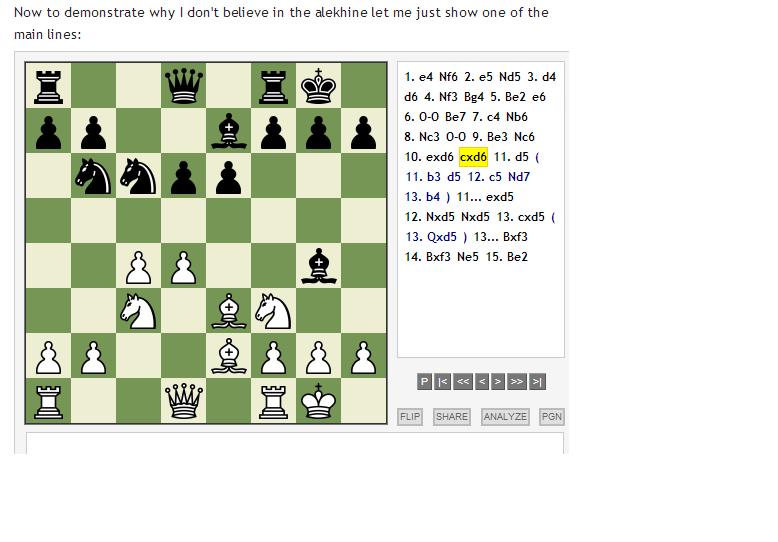
I play this line called the Alekhine Defence. It lets white chase black's knight to the edge to create an asymmetric unbalanced position.

On another forum someone commented on the same system:

'Playing the Alekhine is like driving a Ferrari without the speed. You're doing way more work than the others and you aren't really doing much better with it. It's tricky in that you put yourself in awkward situations to imbalance things. Anyway I'm sure anyone under master can use it. The real question is whether it's even worth it...'.

----

This type of insight hurts, as you put investment into this and it could be in vain. Is the solution to try harder and make these positions work for you. In other-words play from these sub-optimal positions as Black and work it .... work it .... work it .... until you are expert?

Or just find positions that are equal in the first place, and then work from that platform, via an orthodox chess defence in the first place. (I do admit to being drawn to Petrov's Defence).

Yet at armature level reading the board is hard. I played white today vs Alekhine's Defence and still I came unstuck - AND I know this system as Black! The shapes are not normal and keeping tabs on the ideal placement of pieces chasing the theoretical advantage in an irrational context of a time-pressured game is not easy. This has happened a few times. I want to avoid the system I know which is 'bad', as I cannot cope with it ?! 


Friday, May 03, 2013

What is the point : ? 'Searching for Bobby Fischer' Master Certificate (1993)


This clip has many meanings. For me it shows why chess sub-culture can relate to other cultures that involve learning 'apprenticeships'.

The novice wants validation of progress. What is 'progress' is the knowledge ... but something physical  is needed to demonstrate that - a 'token'. Here a young Josh Waitskin, when he was a chess prodigy, like many children I suspect wants a certificate to boost his self-esteem and show 'progress'.
The mentor played by Ben Kingsley is trying to show that the token of progress is not the goal ...

This trap to fall into is easy at martial art level. In Josh's book, The Art of Learning, he has an epiphany and later decides chess is not for him and becomes a Tai Chi master. During his 'journey' there, he notices people who become 'form collectors' , people who pick up sequences of moves, for its own sake, rather than the understanding and the slow graft to understand these moves authentically. Belts can do this, too. The desire for belts to show progress can represent tokenism, where the belt becomes the object of desire not the understanding and the graft and the intrinsic merits of the activity. (This relates to process vs outcome orientated goals - in a post I made below, a couple of years ago).

Moving learners to become appreciate of process goals, rather than outcome related goals, can increase their adherence to a tasks, should set-backs occur. They become resilient.

Here in this clip, the trainer - is expelled from the house but he tries to justify his reasons to both Josh and his Mother. He has a point. The McDonaldisation idea of him reproducing the standardised certificates does link to a McDojo, type feel, of the 'token' being meaningless ultimately. The way he dishes out the certificates is like a photocopier, or a machine stamping out beef burgers. There is no craft behind the certificate that way.

Josh does not know that, however, as he is too young to be able to have any experience to judge progress. This applies to any learner, who is new to a craft. How do you know you have made progress, if you cannot judge for yourself, as you are not experienced to judge for yourself? This sea of doubt goes with any learning territory like chess martial arts, starting out on a degree etc. You have to ride it out and over time changes occur, that become visible to yourself. You do things, think new ideas for yourself without being shown. < This for me is an example of validation.

Thursday, February 14, 2013

Making the Low Cost but Effective Wing Chun Dummy MK.II Video - Khai Tuo...

This is an excellent revision to the previous video  below. Some good thinking in here, which deserves  merit. Thanks for sharing this! 

Sunday, December 30, 2012

wingchunoctopus


This is a really good video as it shows some innovative thinking about the Wing Chun dummy.
There are some arms added, which makes the practitioner re-consider footwork patterns.
Randy Williams talks about the 'V' shape footwork and how the 2 extra arms affect the drills / partner relationship.

Also, what I liked is that he kneels down to use the dummy. I have not seen anyone else do that before, as it makes you think about height-levels in a new way.

Some of the comments to the video think the extra arms could teach bad habits as you could be tempted to reach to the extra set of arms rather than step to them or pivot into them ?!

I think this is a good idea.

Thursday, October 25, 2012

Autumn Dummy 2012

In keeping with the odd seasonal picture .... I took this.

The red tree had shed some Autumn leaves and it looked like a red carpet. I went in to get my camera. There will be a cold snap soon, so the leaves will fall off, shortly.

We did some triangle footwork in training the other day, and I nearly posted a picture of an apple turnover to signify the 'V' shape but thought better of it. (You cannot dispute the loveliness of apple turnovers, however).


Thursday, October 11, 2012

Innovation - look at other sports

This link here shows insights from Neville Southall, Everton's goalkeeper in the 80s and 90s. He was a well respected keeper and thought of as best in the world, for a time, in the 80s.

He talks about how he sought to improve, using alternative ideas.
For example:

  • Dressing in black to make himself look larger
  • Wearing the cheapest plastic boots, rather than the sponsor's top range shoes
  • Getting to the ground earlier than everyone, to familiarise with the surroundings

In this account he states even a 100 changes to make a 1% improvement is worth it, at elite level.

One memorable game I can remember, is the second[half of the 1995 FA Cup final, Everton vs Man Utd.
Man U, threw everything at Southall in goal, to get back into the game and Southall did everything to stop that! 


Thursday, June 07, 2012

Making the Low Cost but Effective Wing Chun Dummy By Khang Tuong Nguyen

This seems like a viable design for a wooden dummy. I like the way the body can  be moved up and down the post for variable height. That is very useful. Notice in the video where his Dad, got the idea from  for the body - Sushi rolling mat-thingy. 
The arms come from a table leg - that is interesting.  The design they have for the legs  could be simpler, as it has  groves in but that is not inevitable.
I would like to see him use this, to see what type of force it can take. I  like to see what they would consider doing about a leg for it.  

Thursday, May 24, 2012

Skipping like a girl?

I wish I could skip like this girl! I bought a  skipping rope  a  few weeks ago and went to use it now the weather is warm and I can go outside where there is space to skip.
  • First thing. I cannot skip!
  • Second thing. It does test your  co-ordination. This video did say that.
  • I had to set myself a realistic  goal, therefore, to adhere to the task.   
  • For me just getting the rope to go over my head without mangling up on my body was that goal.  (I did manage one skip however, a few times) But I called it a day, as that was enough.
  • Today, I managed 5 skips, before it got mangled up.  I could feel myself getting all light headed when a pattern started and as soon as I was conscious of that  .... rope gets mangled. 
  • My next goals will be to build up the number of skips and then once I am automated in that , learn some other skipping footwork.  

Sunday, May 06, 2012

Pushing Body & Mind: Richard Gomm Making the Most of the Micro Jan 1983


This video is very inspiring because it shows someone pushing their body and mind.  The two are linked.

Richard was studying for a PhD at the time of this program shown late at night on Mondays on BBC1.  (Look at his book shelf, when the camera scans it).

The program was called 'Making the Most of the Micro'. This person is probably one of few who really had learned to program and use their computers for productive purposes, too. He says he had to teach himself to create new programs to help him. (The signature he creates, is made of full stops joined together - very cleaver - and adds a personal level to the communications he makes).

He passed his PhD and there is a book about his life, written by his Mother. I want to get that.

Tuesday, February 28, 2012

Excercise .. a re-think!

Exercise ..... mmmmm.... a hard cardio work-out I mean  ... I love to exercise -- the burning lungs ... the sweat ... the feeling you are going to collapse .......yuk yuk yuk, don't be silly.

I see the cardio side, as a chore a lot of the time. The dull repetitive tasks are not far off working on an assembly line. And like the latter you only do it for the outcomes - the benefits being health related.

Ways around the repetitive nature of exercise in martial arts, can be to do moves and drills that also look like the moves you do in your art and there is overlap. < This is what I do now, with my mini-weights.

But to do these moves burns up the energy store you have. In training with my colleges Slippers and Sleeve, you can see after a 3 minute round the effects hitting a pad has on you. Pufff, pufff puff. (Sometimes the sensation to vomit). This is why cardioid-exercise is a necessary evil for self-defence. No engine, no gas ... can't run off even!

This web page on the BBC and the supporting Horizon program, really fascinated me. It shows how individual differences in people will affect the responsiveness we have to exercise regimes. Blanket advice is 'exercise is good for you'. The implications of the program are - types of exercise need tailoring to types of people whose genetic makeup makes them responsive to some types of exercise, not others.

http://www.bbc.co.uk/news/health-17177251

and

http://www.bbc.co.uk/programmes/b01cywtq

(If you are outside the UK in theory you cannot see the program - but there are ways).

What interested me is the short intensive exercise of 3 x  20 second all-out bursts on a bike..... And that is it!  I had been told about tabata exercise before - is this that ? Look at the evidence for the benefits given. See also what did not change.

I will explore the related academic paper soon:
http://www.springerlink.com/content/h774562781l24jq0/


Sunday, February 26, 2012

BBC 4 radio program on Kung Fu

Here is a link to a BBC Radio 4 program of the impact of Bruce Lee and Kung Fu in the 70s.
He is seen as the catalyst in diffusing martial arts to the West.

The program is called 'In Living Memory - Kung Fu'.

 http://www.bbc.co.uk/programmes/b01c7rgs


Also, in here they interview an academic from Cardiff, who has an interesting blog, too:

http://theorizingbrucelee.blogspot.com/

I liked the way in the radio program they mention how the film 'Enter the Dragon' (1972), promotes Lee like a James Bond character. Also, noted is the representation of the Orient in this type of genre (thinking David Carradine's series Kung Fu), which uses stereotypes of Eastern philosophy which are just not realistic outside a California beach. This type of representation is a form of 'othering' that sets apart people as being distinct. (In the blog above there is a picture of Chinese characters in English pantomimes - have a look for that). The program ends saying that the martial art shown in the film is 'a fake' simulation not authentic martial arts. A film's symbolic construction.

Thursday, December 29, 2011

Review of the year

Review of the year

This year I made some advances in the forms / Jurus I have because I used my own private language to make sense of the moves to me. It was no good someone saying to me 'show me juru 3 left side' - sorry I don't think in numbers I am not Leibnitz.
Breathing. A problem was identified in that I was holding my breath in my drills. Had to overhaul the way I breath in and out now and be really conscious about it slipping into a mismatch between movements and breathing.
Towards the end of the year I started using small weights and these have made some physical difference to me. They are not heavy enough to affect my joints or make me like Arnie, but I can feel a difference in my muscle composition. I will keep this up to see what long term affects this has.
I can root myself better now, as I can sink like a sack of potatoes more readily, rather than remain standing up straight.  Like the breathing, I knew you are supposed to do this, but it is becoming automated, more so now.
Found more ways to do silat moves on the dummy. This is not really hard, but you need imagination.
Got a camera to record myself on the dummy and shadow boxing. Been meaning to do this for ages. It does show you finesses to adjust and change. E.g. leaving the centre open and having 'chicken wings'.


Maybe I ought to have some New Year resolutions ....

Thursday, August 04, 2011

Theory - what is it good for?

Here are two videos of two disparate activities: chess and martial arts. You do often get comparisons between the two but these are not always that detailed.

Here is one similarity - reverence for 'the center'.

In chess, if you can occupy or control the center, then, you take space away from your opponent. Also, you can swing your pieces left or right, or crash through more economically - i.e. take less moves to make more threats.


In Wing Chun, the center too, is important to defend and attack down, at the same time. If your hands occupy the center you can deflect on-coming attacks from the left, right and center economically, as your arms do not have to move as far, as if they were parked on the edge of your body. Also, if you occupy the opponents center then, you can enter more easily to create threats on them.

So what? The point is the role of theory is to simplify and explain things. In chess you have a forest of possible moves and things to do. The role of theory and, here - 'the center' for instance - is to simplify your task and make meaning of the game and where you should put your pieces. Same for Wing Chun. The theory gives you something to think with and about. I.e. where should I defend and where should I attack? What should I be doing with my arms. This simplifies the choices to be made when interpreting a scuffle.

Theory is not actually to complicate. It is to simplify, that is why in academic courses such as social sciences effort is made in introducing learners to theory, to actually show how it is a tool to make meaning of a messy world by focusing on just a few prioritized ideas. You do not have to come up with novel ideas why things operate, or how they operate. You take the theory off-the-shelf, as someone else has done the spade-work.

The last theory we looked at was Beck's theory of 'the risk society'. I am not going into detail about that - but will say it gives us a focus on a few ideas to make meaning of why modern life offers anxiety and paradoxically decreased trust in experts, but yet also a reliance on experts in the modern age, as the threats we face are invisible and we need their help.

A theory I was learning about was 'existentialist counseling'. There  the theory focuses us to realize what it is like to live life and understand it is not pre-determined, but we have freedom - i.e. choices to make. The weight of these choices is crushing upon us - and causes anxiety. Anxiety is part of life, which we need to embrace and according to Nietzsche we need to love our fate. If we can do that we live life authentically and not in bad faith. The issue of freedom and the problems it gives us is the core of this type of counseling. It has its principles in its theory to make meaning out of troubled lives in the counseling setting.

The theory is 'the center' then to be focusing on here, and also showing us what to ignore in doing your thinking. It is a simplification, but it speeds up analysis time in any of these activities when you think with these precepts, and take them as a given.

Sunday, June 12, 2011

Implied and applied

I can't stop watching this video it is Junko Fukuda doing a form from Tai Chi. Wathcing her and listening to the chosen music is really hypnotic.

Watching this is not a dreamy passive activity, however. Think about some of those shapes

she has. How might they have martial art applications? There are direct attacks in there

like pushes. There are indirect shapes in her movement that need a tweak to be applicable

for self-defence. Sifu Slippers uses a distinction in his speech, (and therefore thinking),

between applied and implied actions and meanings in forms.

Applied, are direct one-to-one uses for shapes in forms. A punch - in the form = a punch

anywhere. An implied shape, is one that is suggesting the existence of of moves ... subtlety and

deliberately vaguely, I think, to maximize it's use to diverse situations. [I see her knee

to chest as a defence to kicks - they do this in Thai boxing, but it can also be an obvious chambering

for her kick subsequently, too]. Seeking out the implied moves is half the battle, half the

mystery and half the frustration of classical arts. It involves homework and repeated viewing

and learning and relearning. Using the language of our social science course at the Open

University - it is making and remaking .... of understanding. The practitioner is also making

and remaking these moves and gaining new insights as well as building the body and mind,

(but I cannot really talk about Chi flow etc. as I do not do Tai Chi - which has a medical

side to it).

Also, watch the background. How does that grid on the wall help the viewer?

It shows her moving in 2 dimensions: imagine her moving into the boxes (X-dimension), and

also moving up and down them (Y-dimension). What is missing? The Z dimension - although her

body remains on one plain, her feet and arms do stray - which is hard to capture in 2D,

unless she has a straight line on the floor and we can see her feet - especially - when

they move into and out the Z dimension.

That music. Think about that. That dreamy violin does not play any broken sounds but bends

the pitch of the sounds. This implies the moves are not broken either, perhaps but flow

from one to another. Yet also the pitch stretches back and forth - like the practitioner in

her movements. The way the key changes in the other sounds and repeats also shows a

pattern of repetition. There is no beginning or end in this tune. Although there are 24

moves in this form - you are meant to keep these up everyday ... forever ... as life moves

on in a cyclical pattern like the tune. There is no break. 24 hour cycles go on, and life-

death-new life patterns are made and remade. I *think* this is why the ying and yang shape

is a circle - as there is no begging or ending in that. Like the music.

One of my goals in life is to learn this form. I know it can be done - but it will be no 

joyride. It is called the Yang 24 simplified form. Simplified because it used to have

something like 80 moves in it and take up more space to enact. But the Chinese state

wanted a shorted exercise to fit in with workers life patterns to perform before work, hence the 'simplified'.

This does not mean simple, however. Look at her balancing on one leg, in parts of this. Wow.

Saturday, April 02, 2011

Psychological Skills Training

http://www.open2.net/olympicdreams/psychologyvideo.html
This clip shows some athletes and a sports psychologist talking about the value of psychological skills training.

After training, the other day, I had a discussion with Sleeve and Slippers, my training partners. The discussion orientated towards the value of PST and what can be expected out of it. One moment of the talk focused on a hypothetical point about Mike Tyson and how PST could or could not help his opponent. One of my training partners was skeptical as Tyson's skills are untouchable and out of the equation. PST would not be of value here. (I hope this reflects the point being made).

I tried to counter saying that PST would be of value to the practitioner in achieving their potential, in order to maximize their chance against even world class opposition.

I sensed the debate was talking in parellel as there were different standards being applied here to the point or 'needs' of the althetes using PST.


Maybe these concepts help: In terms of goals, it is possible for an athlete to be outcome orientated. That is be just concerned with 'win / loose' scenarios.
Winning and losing is the point in sport and this is fair. It has been said that this type of outcomes only type goal causes pre-competition anxiety. And is not the best goal to have alone. Better is to include or replace this with ....

Process orientated goals, where the 'doing' of a specific skill is perfected - as you can be in control of this; and the same for performance orientated goals - where you seek to maximize your behavior in competition - so Sleeve gave the example of a personal best time for a runner.

The point is these latter two goals are in control by the athlete but the outcomes oreientated goal is not controllable, as the opposition has something to say about it and want to mess up your chances.

  • Slippers once told me that you have to be in control of yourself to be in control of others. In this last respect maximizing and optimizing your performance is a valid focus for training *IF* removal to mental barriers to performance exist. [We all have off days in training, where we leave that jab out - but do not normally, or get tired sooner than usual etc.].

Examples of where practitioners are not in control of themselves is in choking, where they underperfom and that memory of a missplayed technique haunts them and reurfaces in their play to mame other skills and the vicious cycle continues. That is the self - defeating the self - not just the competition. A way of controlling choking is needed, to eliminate bugs in the software.

In the video link above, you hear about techniques such as
  • self-talk or 
  • pre-competition routines
These serve some value for practitioners to be in control of themselves in their question to optimize their performances.
Weinberg and Gould (2007) in their book, do note studies that show that the more successful athletes do practice PST, than those who are less successful, who don't.

The issue is PST is a skill and like physical skills, it needs repetition to hone as you are mastering the way the mind is habituated, which is as hard as a physical skill. Plus, training the mind to learn new ideas and new routines is not something that we are taught at school or easily picked up without some help. Adhering to acquiring these skills is as hard, I assume, as keeping up the physical training.

Do you agree / disagree with this, anyone ?