Saturday, April 02, 2011

Psychological Skills Training

http://www.open2.net/olympicdreams/psychologyvideo.html
This clip shows some athletes and a sports psychologist talking about the value of psychological skills training.

After training, the other day, I had a discussion with Sleeve and Slippers, my training partners. The discussion orientated towards the value of PST and what can be expected out of it. One moment of the talk focused on a hypothetical point about Mike Tyson and how PST could or could not help his opponent. One of my training partners was skeptical as Tyson's skills are untouchable and out of the equation. PST would not be of value here. (I hope this reflects the point being made).

I tried to counter saying that PST would be of value to the practitioner in achieving their potential, in order to maximize their chance against even world class opposition.

I sensed the debate was talking in parellel as there were different standards being applied here to the point or 'needs' of the althetes using PST.


Maybe these concepts help: In terms of goals, it is possible for an athlete to be outcome orientated. That is be just concerned with 'win / loose' scenarios.
Winning and losing is the point in sport and this is fair. It has been said that this type of outcomes only type goal causes pre-competition anxiety. And is not the best goal to have alone. Better is to include or replace this with ....

Process orientated goals, where the 'doing' of a specific skill is perfected - as you can be in control of this; and the same for performance orientated goals - where you seek to maximize your behavior in competition - so Sleeve gave the example of a personal best time for a runner.

The point is these latter two goals are in control by the athlete but the outcomes oreientated goal is not controllable, as the opposition has something to say about it and want to mess up your chances.

  • Slippers once told me that you have to be in control of yourself to be in control of others. In this last respect maximizing and optimizing your performance is a valid focus for training *IF* removal to mental barriers to performance exist. [We all have off days in training, where we leave that jab out - but do not normally, or get tired sooner than usual etc.].

Examples of where practitioners are not in control of themselves is in choking, where they underperfom and that memory of a missplayed technique haunts them and reurfaces in their play to mame other skills and the vicious cycle continues. That is the self - defeating the self - not just the competition. A way of controlling choking is needed, to eliminate bugs in the software.

In the video link above, you hear about techniques such as
  • self-talk or 
  • pre-competition routines
These serve some value for practitioners to be in control of themselves in their question to optimize their performances.
Weinberg and Gould (2007) in their book, do note studies that show that the more successful athletes do practice PST, than those who are less successful, who don't.

The issue is PST is a skill and like physical skills, it needs repetition to hone as you are mastering the way the mind is habituated, which is as hard as a physical skill. Plus, training the mind to learn new ideas and new routines is not something that we are taught at school or easily picked up without some help. Adhering to acquiring these skills is as hard, I assume, as keeping up the physical training.

Do you agree / disagree with this, anyone ?

Saturday, March 26, 2011

Mr.Jinx

I was training with Slippers a few months ago, hitting pads and doing drills. One drill we were doing looked potentially dangerous and I was slighlty worried I may hit my partners teeth.

To protect teeth we usually use mouth guards, but they need to go in early in the routine or else you loose momentum and flow in the training, in order to take a time-out, to fit them.

I told Slippers "This is dangerous and I may hit your teeth".

Slippers replies " Don't say that you will jinx it".

I was surprised at that reply, as Slippers is part of the Enlightenment moment and subscribes to science and reason and all things the Renaissance, too, brings in.

Yesterday when reading my sports psychology book on 'concentration', I came across a related idea, that may link up with this idea.

Apparently research called 'ironic processes in sport' has shown that trying NOT to perform X, actually incites the chances of move X actually occurring. The reason for this is, when you say or are told 'don't do X', your brain can conjure up the idea of X - that it knows how to do, as it is in the detail of the command. (Source Weinberg and Gould 2007,p.380).

 This means that a jinx can be based on probability then, in this context.

Does this tally with anyones experiences in their activities ?

I know when I am making notes in my book and I start over-thinking how to write my idea, (e.g. in a limited space at the bottom of the page I need to squeeze in a sentence), more than likely the sentence is messed up and I have to cross out and re-write the sentence and there is even less space now than before.

According to the chapter I read, this is possibly because an automated process, (writing), when elevated to a conscious level, labours the brain and chances for errors increase. The chapter mentioned, this is how an aspect of gamesmanship can work: complement your opponent on his technique "great follow through" - which is automated ... and you provoke the move to become propelled,  instead, by the conscious part of the brain and over-control the move. (This may also take away the brains capacity for performing or analyzing other tasks).

When learning a move you want to be consciously controlling your body but when reviving the move in performance in competition, for example, conscious thinking is not optimum. The brain needs to be looking and analyzing other variables such as external context - where are others stood - what will be the best person to pass to, etc. The narrow focus of move performance is a distraction, or rather, a miss-matched attention style to what is needed.

Saturday, February 26, 2011

Why else jurus, forms and Kata are good for you

Beyond mood, jurus and forms could be of benefit is related to the link between exercise and mental health.

Here is an extract taken from a report: Physical Activity and Mental Health: the role of physical activity in promoting mental wellbeing and preventing mental health problems - An Evidence Briefing May 2008, (Whitelaw et al. 2008).

"The notion of there being a range of possible explanatory mechanisms that explain the nature of the association between physical activity and mental health was introduced in outline earlier. In more detail, these are:

biochemical & physiological: improved mental health is linked to increased core body temperature; increases in endorphins; changes in the serotonergic systems and effects on neurotransmitters;

improvements in fitness and weight loss: improved mental wellbeing is associated with the feeling that the body is fitter or more ‘toned’;

‘mastery’: effects are linked to increases in self worth and personal control that come with the mastering of new physical activity tasks;

‘distraction’: positive outcomes are associated with the tendency for physical activity to take us away from stressful parts of our lives;

social interaction and sense of belonging: mental wellbeing benefits can arise from the collective experience of being active as a group38;

social and cultural value: physical activity is largely seen as socially and culturally ‘virtuous’ and therefore has the potential in itself to increase self-esteem"

(Source: Whitelaw et al, 2008,section 3.6.1).

Thursday, February 24, 2011

Forms and jurus are good for your mood

Generally when I train solo, I feel better for it.

 A reason for this is a change in mood state. This link between exercise and mood has been noted in the sports psychology and exercise literature and I wanted to share one or two points I came across.

  • Rhythmic abdominal breathing: Both aerobic and anaerobic can be useful here. (Previously only the former was seen, as beneficial). This means thinks like Tai Chi swimming and yoga count here ! The particular juru, that I use, emphasises breaking in for some moves and out for other moves. This may explain why I feel better in my solo training. The rhythmic effect of the breathing is at play. (NB not much in the Wing Chun literature emphasises breathing patterns during the forms. One notable exception if Randy Williams' work - he does place emphasis on this in his videos, I recall). 
  • Rhythmic and repetitive movements. This is tied to the above as well. It is obvious forms and jurus rely on this. My book says this frees the mind to focus on more important issues - but I am not totally sure I do this in forms. Although, going for a 'walk in the rain', is often an activity cited when inverters have eureka moments. The rain clears the air from dust and maybe purer oxygen gets to the brain ? (Same in the shower ?).
  • Closed and predicable activities : where the environment is controllable (in the exercise activity) distractions can be ruled out and you have control over your circumstances. You can pace yourself. The jurus are contained activities and no novelty enters into this. 116 movements too on the dummy - same thing. No novelty involved in that cycle of rhythmic repetition.
(Source: Weinberg and Gould 2008,p.404. Foundations of Sport and Exercise Psychology).

Monday, January 10, 2011

Sticking to things

I suspect the New Year has brought in many 'must do' and 'things to do' promises for people.

Gain muscle, lose weight, run faster, pass that grading, start that philosophy or sports fitness course etc. These are all worthy goals but will people stick to the regime of work to achieve these ends ?

This post is about adhesion  and sticking to your path of activity. I am doing a sport psychology unit and this diagram comes from one of the models of adhesion we looked at. It really caught my eye, (I will say later, why). To achieve the new goal we have to behave in a new way.

 "Figure 8.3 shows how an individual goes through a cyclical series of stages when they change a behaviour. They may start off having had no thought or desire to change their behaviour (precontemplation), but then something may cause them to think about changing their behaviour (contemplation), which will lead to a period of preparation followed by action, which, if sustained, will in turn lead to maintenance. However, the individual may not sustain their changed behaviour, which will lead to the termination of that behaviour".

Rea,S. (2010) 'Adherence and group dynamics' in E233 Sport and exercise psychology: a case study approach, (2010). The Open University.

I can map this model onto my own 'journey' in martial arts, (and other activities that involved behavioural investments).

So precontemplation is when I did no martial arts but way well have been aware of Karate from playing computer games and films. Contemplation is when you start toying with the idea of doing the art but it is in the 'things to do / nice things to want to do list'. Here I saw someone at church who new Wing Chun give me a demo. He was Chinease and I was under the assumption this was a magic power he had, as his sticking hands and blocks were of good quality and he showed me the theory that underlies what he was doing. (Theory is the blue prints to any activity - get your hands on that to make your life easy - from academia to chess etc.).

'Preparation' for doing some martial arts came from buying books and borrowing library books. I wrote the British Kung Fu association for a local group. (note the singular here this was the 80s and there was not that much available that was not Shotokan). Note too, this is actual activity that is compatible with my goal. I am doing something not just mental.  This is 'work'. But it cannot stop here.


Action. Doing it. I took JKD lessons. I could not believe I had actually rung up someone and had the courage to do this. I remember when I had committed myself to the first lesson thinking 'what have I done now'. But I did it and had more lessons and did another martial art when I left home. I was stretching and drilling in private. Etc. This was maintenance work. BUT after a few years things stopped. no training partners or classes even. This was a relapse.

Then the cycle began again from 2002 onwards .... where I think it would be a good idea .... and we are back to contemplation again.

This shows us how adhesion is not linear but like the tide, comes in and out.It is cyclical.

The processing of getting and using the wooden dummy is very similar. The contemplation stage lasted about 9 months. I have not relapsed in my use of the dummy. I have never stopped for a long passage of time, just weather affects me sometimes.

The model is useful as if you can plot yourself / others on the cycle then you can find interventions that will modify their behaviour relative to where they are. So if you want to provoke contemplation for a weight loss regime you may want posters of tubby people versus a slim person, (often the same person), laying about. This plants a seed in their mind, 'what if'. Someone who needs help with maintenance would need a different form of intervention - maybe a study buddy, or training partner, as a poster would not be of value there.

Friday, January 07, 2011

What have the Red Baron, 'Mick' Mannock & Georges Guynemer all got in common ?

All 3 of the named pilots, in the title I give here, were elite pilots or 'aces'. They were all, therefore, highly skilled and survived as they knew and adhered to principles that kept them going in stressful circumstances.


BUT that is not what I am focusing on, for their common ground. Rather, they all died as they broke basic rules. Target fixation & flying in a straight-line too low to the ground:


"...Richthofen's behaviour after his injury was noted as consistent with brain-injured patients, and such an injury could account for his perceived lack of judgment on his final flight: flying too low over enemy territory and suffering target fixation.[48]
There is also the possibility that Richthofen was suffering from cumulative combat stress, which made him fail to observe some of his usual precautions. It is noteworthy that one of the leading British air aces, Major Edward "Mick" Mannock, was killed by ground fire on 26 July 1918 while crossing the lines at low level, an action he had always cautioned his younger pilots against. One of the most popular of the French air aces, Georges Guynemer, went missing on 11 September 1917, probably while attacking a two-seater without realizing several Fokkers were escorting it.[49][50]"


(Source: Wikipedia http://en.wikipedia.org/wiki/Manfred_von_Richthofen : accessed Jan 2011).


My point is ... if even these elite pilots get into trouble and break laws of 'the basics' then we will. It must be a question of probability that is the question here. Basic rules and skills, therefore, will probably be forgotten on some occasions no matter how expert you are.


(The Barons article is interesting. I accessed the Lancet to read the paper they mention. He had taken a bullet to the head the year before but still carried on. The sense of duty even when brain damaged increased his chances of being killed. He should not have been up in that plane at all. All of them should have been retired and passed on their skills not burned out like this). 


I chose pilots as an example, as I know the 'OODA loop' is being used from fighter pilot tactics as a way to think in self-defence. That is an ideal method to employ - but does not mean it can be implemented every time. The knowledge of that would increase  your chances, and chances involve probability. In other words luck can be involved in foiling that scheme or just bad judgement in it's deployment.

Tuesday, October 05, 2010

What does it mean to participate in martial arts ?

This is a very short review of an academic paper published in Journal of Sport Behavior; Mar'98, Vol. 21 Issue 1.

It is called 'Phenomenological meanings of martial arts participation.' by Rice and Columbus.

This means the focus of the paper is to understand what martial arts participation and practice means to the participants themselves. The researchers asked participants :

"Please describe in writing your experience of an everyday life situation in which you realized that training in a martial art is, or would be, a worthwhile activity." Also "Participants were further asked to make their descriptions as detailed as possible so that someone else could understand exactly what was experienced before, during, and after the event".

The study was small scale but had 10 male and 7 female martial art practitioners from a variety of arts including Tai Chi and Karate.The results were analyzed for patterns and 4 themes emerged:

Criminal Victimization, Growth and Discovery, Task Performance, and Life Transition.

[Criminal Victimization]

The first category involves the issue of protection. Participants either
experienced threats or 'near misses' and a 'what if' scenario emerged.
This prompted motivation to practice martial arts as it gives a plan of
action of participants. The fear experienced had created a sense of 'vulnerability and powerlessness". Victimization was described in scenarios where people felt' always' scared' for example - even if it was just a perception, such as fear of dark streets.

[Growth and Discovery]

This dimension differs from that above. The category above on victimization is about others who seek to cause harm with confrontations with them. Here this category is about confronting themselves and self-improvement through private challenges. The above category is physical, where this category on growth and discovery is mental, arguably, becuase of the improved 'awareness' mentally. There is however a body dimension where people became more linked to their own physical presence. The teacher and the class are important 'others' in meeting this need of learners. The class are seen as like-minded participants who share the same goal and the sense of co-operation between them was beneficial.

[Life Transition ]

This category I found interested personally. I can see the above 2 fitting in with peoples needs and wants list from a martial art practice and it is what is actively sought after. Here, in this category turmoil in life events causes an change on us: divorce, moving college, financial debts. Life beats us up ! Here martial arts are a way of seeking control and purpose in the overall life-course we are going though. A way of managing crisis.


[Task Performance ]

While reading this paper, I can see Karate Kid I's story fitting these dimensions (above) - (for what that is worth): New school / crisis in life / victimization and growth via Mr. Miyagi. Bruce Lee's scenario is not much different, if we believe the biography that is presented about him and his journey to Jeet Kune Do.
I don't know if this category, here, meets this 'popular culture' type of insight, I note. Maybe it does and I am not thinking enough - tell me in the comments! Here the motivation is intrinsic. It is solving goals - this could be grading, badges or belts. To achieve these needs mastering skills and overcoming uncertainties and worries associated with this from anxiety.

[Overall] 

The big pattern throughout these categories is a 'compensatory' or
'emancipatory' theme. Martial arts practice makes up for something missing or deficient, in the former. Or, it allows a new freedom from self or environmental constraints. Therefore it is a lack vs a gain scenario. This, I find very succinct and insightful way of looking for the 'big idea' in these peoples accounts. So a compensatory use of martial arts is to obtain skills to defend oneself and counterbalance weakness such as being in debt via a lack of discipline even. The emancipation can be seen in overcoming mental obstacles in learning a new skill or finding a new way of looking at the world. On this latter point, and this is something you do not see covered in a psychology journal maybe, is that emancipation is sought in many arts where colonial rule is experienced. If you look at Capoera or Silat, these histories support stories of what the art mean to a collective of disadvantaged ethnic groups.

Thursday, September 30, 2010

Irony


A few years ago when returning from the West Country I was on the train from Reading and started to read a biography on Bruce Lee. It was written by Bruce Thomas, a bass guitarist for Elvis Costello and The Attractions.

Thomas writes in the book favorably of this teacher, Derek Jones, who taught him Wing Chun. What I find ironic is Thomas does not credit Elivs Costello himself for his stance ! I must confess, if you google images of Costello, you will see him in this stance quite often. THIS IS NOT DUE TO CHANCE.

Saturday, August 21, 2010

Authority


Below is a dialogue from a comedy called Blackadder (1983), it is set in the Middle-Ages.


[In meeting room, Harry is holding a council with various lords].
 
Harry: My Lords of the Council, we face today the gravest crisis this country
       has known since the Roman invasion.
 
All: Hear hear!
 
        (an officer enters, carrying a helmet)
 
Harry: Therefore, I propose--
 
Officer: Your Highness, the King has stirred and calls for you.
 
Harry: Ah. (swallows nervously) Very well. (removes his hat; stands) Gentlemen,
       I must leave you. (takes the helmet from Officer and draws his sword,
       preparing to meet the deranged King) Prince Edmund is in charge!
 
        (Percy begins to bang on the table in approval, but all the lords
         mutter "Oh shame..." so he stops. Harry and Officer leave. Baldrick
         brings Harry's notes to Edmund.)
 
Edmund: Er, yes, right. Gentlemen, right... (reads from Harry's notes) As you
        know, today we face the gravest crisis this country has known since
        the Roman invasion.
 
        (They all make sounds of protest: "Nonsense!"; "Rubbish!"; etc.)
 
Lord 1: What about the Viking invasion?
 
Lord 2: ...and the Norman invasion?
 
Angus: ...and the Swiss invasion?
 
Edmund: Er, well, the greatest crisis for some time.
 
Lord 2: And we all know why!
 
Edmund: Why?
 
Angus: Because the King is possessed!
 
Edmund: What?!
 
Lord 2: True! True! The land is full of omens of bewitchment. Only last week
        in Cornwall, a man with four heads was seen taking tea on the beach;
        and two women in Windsor claimed to have been raped by a fish!
 
Lord 1: I, too, have heard such tales. In (Harrigate?),
it rained phlegm; and
        they do say that, in Edinburgh, the graves did open and the ghosts of
        our ancestors rose up and competed in athletic sports!
 
Percy: ...and a friend of mine had this awful pimple on the inside of his
       nose!!!
 
Edmund: Percy, shut up, for God's sake.
 
        (There are mutters of "Witchcraft!")
 
Angus: ...and a farmer in (Rye?) heard a cow reciting Geoffrey Chaucer; and
       a young woman in Shropshire saw Geoffrey Chaucer in a field, mooing
       and suckling a young heifer!
 
Edmund: Gentlemen, gentlemen, surely we aren't the sort of people who believe
        in this sort of thing. I mean, next you'll be telling me is
        that washing your hair in bat's droppings stops you going bald.
 
Lord 2: But it's true! I couldn't find enough bats, and look what happened!
        (removes his hat to show his baldness)


I put this script in here (which can be seen on youtube, if you search about), as it shows the issue of authority really well.


Authority is where you can get people to behave in a certain way – even if they like it or not – and you don’t have to resort to force to get them to do that, as your right to do so is recognized and not contested.


In this example Edmund Blackadder has no authority – or rather it is not recognised, but his elder Brother's authority was. See how the group of Lords start to question the very same statement made, once Edmund takes over.


In martial art teaching the search for authoritative knowledge is a big battle. Who can we belive, what knowledge counts as ‘true’ or not is a big source of anguish for many. Some use tradition and brand names of teachers to derive the legitimacy of knowledge claims.


I remember when I did JKD. The teacher put me in charge of a newcomer to do hook-kicks. They the kicking shield and started the demonstration. When it was their turn to go, I started to ‘correct’ them, in the style of what our school did. The newcomer said ‘oh, no – this way is much better’ – and proceeded to do what they wanted to do.


I wondered what to do. They weren’t really listening to what I had said – or been shown myself as 'correct'. So I called over a trainee instructor, and thought if the newcomer does not believe me, then they will believe him. But then what happens is yet another way to ‘hook-kick’ is shown. And the newcomer adopts that way, as they recognised the authority of that insight over mine. THEN, the teacher comes over and says ‘ why are you not doing this kick the way I showed it, and was I [me] not doing as we were told’.


I was really annoyed at this, as this was in fornt of everyone. I tried to explain, but the teacher said I am in charge and it is down to me. I looked a the newcomer and wanted to slap him ! And I wanted to slap the trainee instructor for just hiding away there – as we had reverted to his method.


My point is, authority as a basis for learning and basing belief upon needs questioning all the time. Sometimes the boundaries of authority are like a parental figure an they need to be there to like a walled garden to stop people believing what they want to believe and do what they like. Sometimes authority does have to be questioned, (bats dropping for baldness ?). The grappling movement has been good at this, for provoking a rethink to approaches in traditional martial arts that do not question their premises and training methods.


My example was from a more micro-social example. If ‘I’ said I had seen a cow reciting Geoffrey Chaucer, no one would believe me. If the Bruce Lee had said that – I bet some would believe, due to his authority !

Thursday, July 22, 2010

Book Review Wing Chun Kung Fu: The Wooden Dummy. Rawcliffe.


Of books that are on the wooden dummy, this is 'up there', with Randy Williams' work. That means if you are interested in the 4th form of Wing Chun, you should own this book.

This book talks about the authors acquisition of knowledge about the dummy, his source of knowledge and examples of sketches and notes he made from his interaction with Ip Chun, (Yip Man's son). Insights gleaned for instance relate to the meaning of some moves, such as the upward slapping hands - tok sau - movement that separates the sections. The book reveals this could have been just a re-calibration move to make sure the arms are in place, before the next section.

What is more important, however, is the books delivery of the form. It achieves this well by it's attention to detail in the written comments. The sections are broken down and verbally explained well. I am focusing on the words - not the pictures alone - which are detailed and in colour, as well. The written description tells you where your force should be going and which direction. This is really vital and pictures alone could not deliver this information. No YouTube video can deliver that, either.

The book uses bullet points well to zero-in on core ideas and mistakes and this draws the readers attention well to the essentials. 2 novel aspects in this book, (which Rawcliffe also uses in his other book on Wing Chun), is to have 2 sections written by a physician, offering physiological insights into what the moves mean for the body, and how the body adapts itself. And, there is a section on learning and how drilling works - using the types of learning styles, (kinesthetic, visual, auditory etc.). This is novel - relative to other books - but again Rawcliffe does this too, in his other book, as he gets a teacher involved to write that section - good.

Problems with a book are the constraints of publishing - space. The pictures and the descriptions are not always on the same page and you will have to flip over, to co-ordinate them. Also the Chinese terms may not be the same terms you know / use for the shapes you have at your club / school, (remember to translate is interpretive). Yo umay have to put your own mental translation in. Finally, if there was space for foot-patterns then this book would be the best book ! Because Wing Chun is a positional art, in that you need optimal angles to maximize forces and achieve the claims this art makes for it's effectiveness. To do this, then, you need to know you are stood in the right space, the right angle etc.etc. Foot patterns would help here.

Finally, now in an internet age, the 116 moves are no longer a secret. You can use this book in conjunction with online video too, to see moving interpretations of this form. Some practitioners are hard, some are softer in their use of energy on the dummy - even within the same lineage. In fact, that is one area that needs to be noted. Interpretation. The dummy form has been interpreted and modified in Wing Chun_s < Plural intended. A comparison of these interpretations would be very useful.

Friday, July 09, 2010

Arts in Martial Arts II : Performance.

One extra aspect worth mentioning about the 'arts' in the Martial Arts, is the issue of performance. This does have an aesthetic aspect, that means, what you look like will be judged by an 'appreciative community'. That is there is a value or 'beauty' that is given to your moves, that others assess. This could be a brutal effective aesthetic, it does not have to be flowery and pretty and dainty - that is no the point. My point is that there is a social basis to judgment.

If you look at youtube posts, watch how comments ... and stars are given to judge the performances of people doing their moves. The formal arts have this too. There is a culture of critique and judgment of fine art or performance based art - such as ballet. Sports have this aspect of performance in too, this is where demarcation of sports / arts blurs. Look at ice-skating for this. But even talk about football games are judged for their quality of performance and 'entertainment' values enter into this, as well.

Modern 'combatives' is a genre of martial arts that is not exempt from this if we focus on performance and its social basis. It is by default judged on criteria by 'experts' and this is no different from other 'arts' (both broad an narrow meanings given to that).

So what ~?

This is useful in knowing why we do what we do, when 'doing martial arts'. Where is motivation and what powers it. There is a performance aspect to this that feeds into our behavior, if you like it or not. We use it to judge ourselves and our identity - how we see ourselves. But is also a resource, involved in how others see us. And this affects our status, too. We are motivated to improve our performances in training.

I am arguing that in conjunction to functionality there is also performance, too in here, that some may want to deny but it is in here. Don't confuse aesthetic and performance with kata and finesse. See performance as valued activity that is judged subjectively by others. The boundaries of the performance is policed by a community too. Go watch on forums how opinion forms to verify if this or that move is effective / valued ; or if this or that performer is doing it right. This social activity could easily be confused to these 'X' Factor type programs. Ok - one is entertainment driven and the other is self-defence but the root is performance. It is social in its basis. You meet the criteria of positive feedback from these appreciative communities and that buzz and self-worth increases just the same whatever domain you are in.

Friday, April 30, 2010

It really IS a beautiful spring time !!!!


Ah ha ! I was training today in the spring-like weather and realised what this is all about !

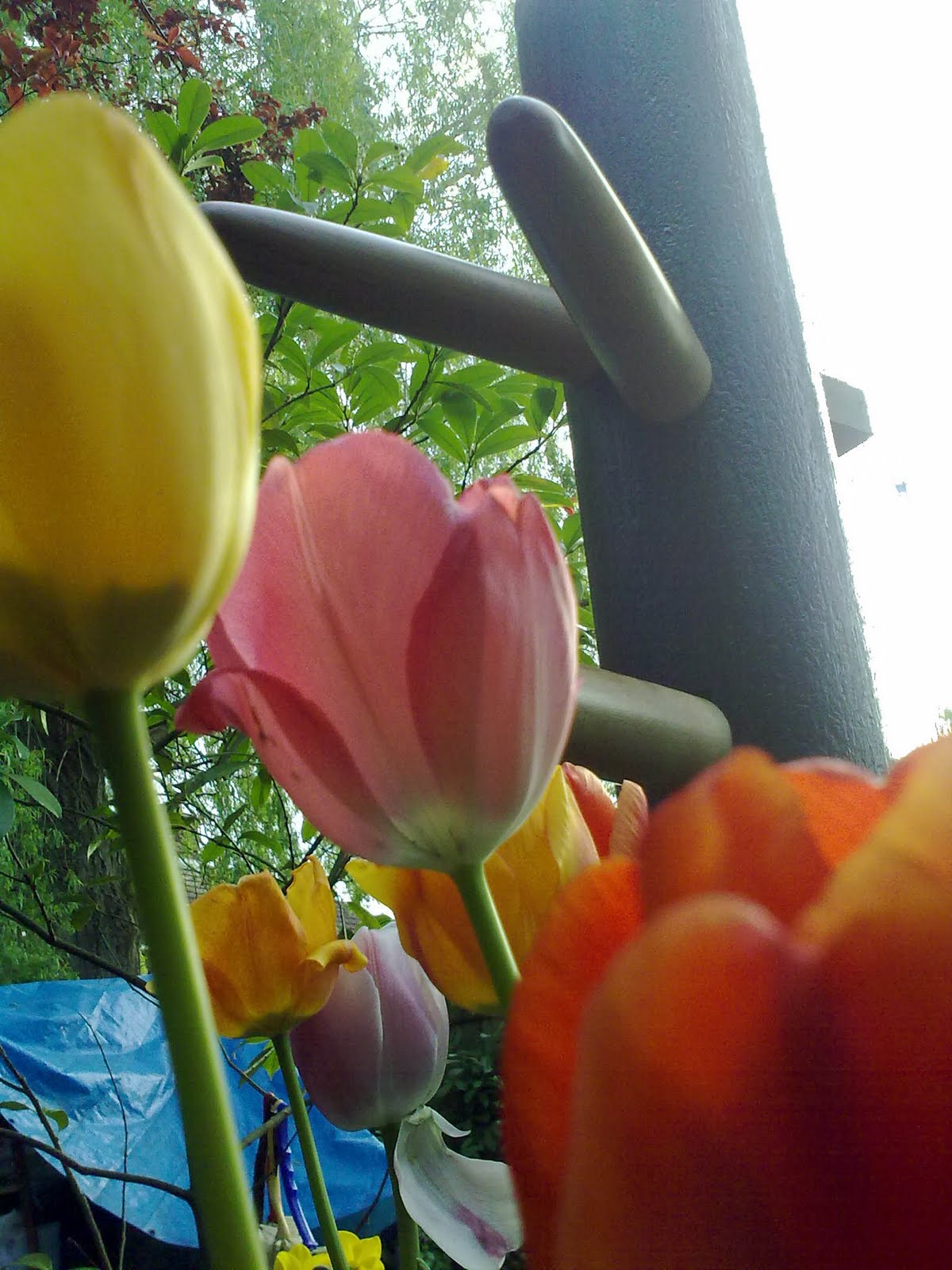
Have many tulips in the garden now and the colours are really vivid. All I need is a cherry blossom tree next to me and doing the 108 movments etc. etc. [OK.. I will stop this as it is getting a bit sickly].

Thursday, April 01, 2010

What do you see - what are you able to see


This is my favorite illusion as the 2 images are so opposite. You love one image, and hate the other. BUT they are the same thing.

This is the same effect looking and seeing forms & jurus have on me. When you look at the strange shapes in a form they look
  • silly
  • exotic
  • mystical ...
Take your pick. (I showed my mother once, the stance from Wing Chun's first form and she started laughing. Picture that stance and the fuk sau and you get the idea).
Then you make a breakthrough and you 'see' what you have been looking at. This is one way the illusion metaphore works. But this isn't the point of this blog entry.

The other aspect is interpretation of the martial arts by practitioners. One aspect of the 'arts' and I am thinking about high art - picasso and such like. See how that needs interpretation for some works. This is the 'art' side I am thinking of for the martial. I am thinking that half the work involved is not in following physical patterns and mimicking them but interpreting them.

In this next picture by Duchamp a work of art is created out of a urinal. He calls it 'the fountaine'. He is being cheeky but the point is interpretation gives this meaning.
"The creative act is not performed by the artist alone; the spectator brings the work in contact with the external world by deciphering and interpreting its inner qualifications and thus adds his contribution to the creative act."

My point is watching experts do their moves is not enough. You have to be active in its interpretation to give and extract meanings out of the martial art shapes. I watched and re-watched forms DVDs and struggled with their interpretation ... and like the pictures above, sometimes you get a snap and you seeeeeeeeeeeeee the idea hidden away in there. Sometimes you don't and you aren't taken in by 'la fountaine' like avant-guarde luvvies.

Sometimes the forms need a leap of faith to interpret and you need much effort like this picture .... 'Nude descending a staircase'. This picture and its type (as above), only makes meaning in relation to a theory. Once you have base ideas in place the picture has value and meaning. Otherwise it's
  • silly
  • exotic
  • mystical
This is why the same thing looks different to 2 different martial art practitioners. Culture also serves to affect what we see. it may not be possible for some practitioners from other traditions to see what you see. They don't share the theory that lets you see.


Here is Duchamps self-portrat. He gave up art for chess. The art side of that is in the interpretation of shapes on squares. He was on the same track if you ask me.

Wednesday, March 24, 2010

Tai Chi Pole Work - their dummy variant ?

This is a great demonstration of 'wooden' apparatus. This way of using the pole means he gets balance into his feedback from the pole. The way he does his push hands is like chi sau (a bit) and there is value there, as there is some resistance from gravity.
The way he recovers the pole once it has hit the floor is very good. Well worth looking at how he does that / inverts the pole / throws the pole and mimics headlock [?] / partial sweeps or leg trap. Foot work is intricate as he turns his back in a judo throw like way. His arm shapes are like tan to bong transitions.

You 'could' do this on the main pole of the wooden dummy for wing chun, if your design is a plug into base type. Take out the arms, but that would be one heavy pole. If your structure is correct your tan to bongs would work, but the throws on that, plus recovery from the ground would be like a sandbag drill.
I wonder ....

Thursday, March 11, 2010

Snow Stops Play


I went on the dummy for the first time for ages maybe since November last year. The snow had kept me off, as the ground was too mushy. The picture is proof. (I went to pak sau the dummy and palm the body of the dummy expecting the snow to fly off. Errr ... no ... nothing happened. What an anti-climax).

So it's March and I get going on the dummy and what do I do ? Punch a bit, then put the arms on and see what I can remember of the 108 moves. I can do the 1st part seamlessly, then the second part has this funny kick in it, while your arms are also blocking too, (Peng Nam, now not Yip man). My head thinks 'I have modified this and don't need to do it, like this', but also my heart says 'no' this is the real and authentic move. You must stay true'. I compromise and do the kick separate from the arm moves.

This got me thinking that to keep the whole form going in my memory and replay it and maintain it over time, is quite a tax. Is it worth it? I think Bruce Lee's idea of splitting up the form into segments and using the parts you want from it in various orders is better. It is a 'drill/form' then. Also put in elbows for punches in that form, knees for kicks, punches for palms and palms for punches is more likely to arouse the brain than just recall alone, as you are being creative. Doing the whole form in the first place does introduce you to the variety of moves that are out there, however and an honest attempt at them, is beneficial.

The ideas I was using on there intending for sparring went out of my head the next day too. Something I would like to do is to use the dummy in a social context. I.e. have more than one practitioner around. This could be to act as another set of eyes, to see my footing. It could be to offer up new ideas to drill with, it could even be to represent a 2 on 1 situation !? All I have been doing is solo dummy training, with the rare video seen by someone else for feedback. I have never compared notes with someone on the dummy, who is also a practitioner too, and argued through merits of using it this or that way. Have yet to use a wall mounted dummy either - but have used on mounted in a trellis that is supported. It can be chased left and right.

Can't think of direct dummy applications for ground work in guard or mount that are sensible. Maybe you could lye the dummy on the ground and aim for token arm bars ?! You could not have that dummy on you in guard ! (could you ? NO - stop it. Way too heavy).

Friday, January 01, 2010

Going against orthodoxy or tradition ?

If you go against the 'done way', 'tradition' or the 'orthodox' then expect to be confronted by someone like this man in this picture:Return of the Body Snatchers remade around 1978 is one of my favorite films. The idea that others are not as they seem, or just not 'aware', or others cannot see what you see is quite provocative. The film is almost an allegory.
I had a conversation the other day, with learned colleague who recalled a situation where he advised someone to punch with gloves to avoid a pain in their arm. Person with pain-in-arm related advice to Sensei. Sensei didn't agree. So no change in the scenario and .... pain got worse.
This is a martial arts application. It could apply to differences in 'the Yip-Man' 108 which is a sacred form for some people.
It could apply to your company or society, whatever. It can actually benefit you to be not part of a crowd and to step out or change company to get a new perspective. A new set of analogies. A new set of phrases to think with - whatever. This poor chap, above, in the film did at least try but he succumbed.
(Actually this picture was animated and had the man shaking his finger at you, like in the film, but its 'been lost in translation').

Saturday, December 26, 2009

Watch this practitioner - what snappy form!

Wow, watch this practitioner doing the 108. Doesn't matter if you approve of Wing Chun or not. You can't fail to see this practitioners short range 'fa ging' power being snapped out. This is the 'snake style' ,I feel, coming out in her expression of Wing Chun. Those side-kicks she does come out of no where and are really angled nicely. Lovely dummy too - can't fail to want to own that piano black object.
When she does combination of strikes she doesn't pause between them to admire her handy work. she blasts them out, as If they were musical notes they would be triplets, (one beat sliced into 3). You can learn from her, whatever discipline your into, as she has good form.
Someone one the youtube web site said watching her is like a view of what Beautiful Springtime must have looked like ! IN the comments she replies she has been doing this 40 years ! OMG - she looks 20.

Sunday, November 08, 2009

Some Videos I Made Earlier

Here are some vids on the dummy. They have the pegs taken out of the base to make the dummy move about and absorb energy. They are a drill on the dummy, involving backfist and a trap; boxing slips, and short and long range palms. I corrected one palm set, and tried it a new way. The videos had to be fixed from portrait angle, from phone, using software. Otherwise you would have to turn your head 90 degrees. I chose that angle as it allows for capture of body and dummy length. I am fond of portrait angles, but know of someone who is vehemently opposed to this camera angle and prefers landscape. This is an aesthetic rift that has emerged.


Tuesday, October 13, 2009

Thursday, October 08, 2009

The Funeral - by M.Quoist

Here is an extract of parts of a Prayer / Poem by Michael Quoist.
I read this today in memory of my Mother.

People were following:
The family - some crying,
Some pretending to cry ;
Friends - some grieving,
Some bored or chatting.

Leaving the cemetery, some of the family were sobbing: "All is finished".
Others were sniffling : "Come, come, my dear, courage, it's finished !"
Some friends murmured: "Poor man, that's how we'll all finish."
And others sighed in relief: "Well, it's over".

And I was thinking that everything was just beginning.

Yes, he had finished the last rehearsal, but the eternal show was just beginning.
The years of training were over, but the eternal work was about to commence.
He had just been born to life,
The real life,
Life that's going to last,
Life eternal.

Sunday, September 20, 2009

Heavy Metal Dummy

NGC - Pan Ing Lan on this metal Dummy.

I have never seen this design before. It looks like a modified Choy Le Fut dummy. Watch this man clank his arms on this metal object. I would not try this at home children. I wonder if he helps himself out by angling in his muscle to buffer his bone as it clashes. If you 'sheer' in your movements you could get some use out of metal as a medium on the dummy. I have stuck a metal pole in the bottom arm of my dummy as an experiment and it is functional but it makes a clashing noise at it buffers the main body of the dummy. Also without a whole and metal pin there are no lap sau, (pulling hand), type moves, for what that is worth.

Watch him go behind the dummy - that is interesting. You can get a choke on that maybe. The base of the dummy is not raised that high either. Also those arms are sprung loaded at the front. That could be used for Thai clinch type moves. The hand conditioning looks 'very dedicated' - his knuckles are testimony to this. I read somewhere if you train your finger tips like this, it will impair any fine skills you may need your fingers for - piano, threading needles etc. I guess your nerve endings become less sensitive.

Thursday, August 06, 2009

Owning Strawberries


Do you see this image. It represents a character of a short cartoon on the web and is also on Youtube. Its the evil strawberry.

After much thought and consideration I believe this character represents any learning activity that creates grief an displaces the learning goal in a distant place - a forbidden fruit if you like. Its a parable.

In any learning activity that does not come easily, it is hard not to feel frustrated and angry and act like this child - sour grapes !

The key to all this in acquiring a hard skill - and I am thinking of sweeps and throws in martial arts for me at the moment - is resilience. Its a characteristic of the learner that needs to kick in when a barrier to the learning goal emerges. Not dealing with set backs can make you give up and in adult learners who have unrealistic goals, this can happen. I teach adult learners social sciences. Some are very grade aware and have high goals and expectations for obtaining these high grades that makes the subject matter irrelevant almost. Learners in this category are high risk suspects when it comes to managing setbacks and wanting to give up their study.

Developing a different attitude to learning - seeing it as a long haul issue and seeing the intrinsic pleasures are a way to overcome set backs. Josh Waitskin talks about this in his disciplines of chess and Tai Chi. Of how the apprenticeship of learning *IS* the goal. Leave the learning train - lose the attachment to the discipline almost is what comes across. It is a psychological condition coping with set back.


Why am I talking about this ? Yesterday I was going sweeps and I am re-learning and re-learning and not really making head way in this set of moves. I have been here before with Vale Tudo and some of the moves there, which I could not really adapt to. I know what to expect and what is happening to me when I am learning however. I have realistic expectations to a degree with this aspect of martial arts. This realistic view aids me. I could get red faced like this child here, but I just have to accept the moves are hard. I did this while learning parallel park. I can remember the sweat under my arms and the pressure n my face when learning this manouvre for my driving test. I decided to take all pressure of myself and say I will get it when I am ready. Not rushing this. Love the learning and relish the innocence.

This is similar to my feelings of chess. Those innocent days in 1987 when I was learning from books and reading how the Sicilian defence creates asymmetry and nodding at the principles but not really getting them are to be cherished. The mystery of it all does add something. Chiseling away at the mystery is good too, however.

The big difference academia, chess and martial arts and driving here is the sensory motor side. Its very binary in terms of having a skill on the latter 2. You have the technique or you don't. You park in line and can see it for yourself. You can apply a sweep or not. No in between.

You work to get that strawberry in time or you don't.!

Monday, July 06, 2009

Seeing is believing ?

This is a training video with 2 others. I saw what I looked like 'doing boxing' type moves. For a few years now I have been told 'chin down'. I thought I had this idea down by 2005, but it crept back up. Here in this video it creeps up when I try and deliver upper-cuts. OK I am aiming to deliver uppercuts for my friends defences, but if he counters, my chin is on a plate.
You can hear Granmaster K telling me chin down. I have heard this a hundred times. BUT now I see it.

Yuk. I look a poor sight. I disgrace myself.

So what ? This shows the value of video and the idea of seeing is believing. Think of how people put bias on 'eye witnesses'; 'Doubting Thomas' came to believe only when he saw; and the statement 'I will believe it when I see it'. Well this video is massive and got me thinking about video too in general.


Its not totally true that seeing is believing is it. We see lots of adverts on TV and don't believe them ...because we have critical skills. Watching and seeing are interpretive acts. We are matching things up in our heads to what we see.

The issue is these skills can be sharpened.
When it comes to watching martial arts instructionals, we can arrest these skills - excessive reverence can be a cause. Master X or so and so's student does this - it MUST be true. It’s a trap.

Worth thinking about too is how old is this material ? Has the practitioner moved on and changed or modified their techniques ? Maybe they have had a Pauline conversion and renounced their style all together since that video was made as there were flaws in their approach !?

Do you have another instructional that has this same type of material - if so then contrast the techniques. Get a friend in to watch with you to help contrast the moves. Take time to tooth pick their differences. Maybe the practitioner isn't verbalising something that they need to that your friend sees ?

Remember to look at the feet - even in hand techniques. The feet show weight distribution for example or how to move the upper body. They are tied often to the hands. If the camera cuts-off the feet then maybe you have to search down the tape or DVD for an example or find another example elsewhere.

Keep a log of what videos you have seen or own. This will act as an index to look up this or that move. It shows you too how far you have moved in your 'journey'.

Search for reviews on your instructions before or even after you buy them. These can be useful in verifying the value of what you have
. The BJJ community is very vibrant in reviewing instructionals that come out in its domain. There is something very different about BJJ / Vale Tudo knowledge and its socially shared nature. I wonder if its something to do with the physical proximity of training mano-a-mano that creates this ?!

Write notes to accompany your DVDs. These could be stick-men that break down a move. The pause function and A-B repeat is excellent for this [If you have never used the latter - THAT is your homework ok!]. Give your notes to your friends - it could be questions like I don’t get move @ 22 mins in - can you work out what this means ? Or do you trust that arm-lock @ 52 mins ? It could be an index of moves in writing.
After a few viewings the details will melt away or go 'fuzzy'.

Watch the video once and let it gloss over you - this is 'looking'. Then once you have a 'mental map' of what is there focus on a portion to train on that day. And a new portion another day. This creates 'seeing'.

Write reviews. This verbalises your thoughts and forces you to evaluate what you have seen. Evaluation is a high level cognitive skill. Practice it. It goes beyond mimicry or description.

Treat your DVDs with care. Avoid scratching them and implore your ruffian friends not to scratch them when you lend them. If they do get scratched, then there are some remedies like tooth paste being wiped into the scratch.


Tuesday, June 09, 2009

Can't see properly ?


I have a migraine now. My vision has gone all spangly and I cannot see that well. It is not good. I can be sick too with numb arm and messed up speech - like a mini stroke in this situation but this isn't as bad as when I was a teenager.
What if I was out and about and some delightful youth wants to cause a confrontation ? Goodness what nightmare.

What isn't addressed by self-defence literature is what to do if you cannot see properly and need to defend yourself. I wear glasses and if these get knocked off, then with my minus 9 vision I am looking at burrs. With migraine vision I am have blind sports.

Crazy moneky guard would be a good fail-safe here, as you don't have to be that active in your defense - no searching for bridges or interacting on a high reflex demanding defence like a pak sau.. To be honest you may not see it coming with a migraine. You would have to feel the attacker if you could not see them. Here grappling chi sau (for want of a better word), would be of value in searching for that bridge if you want to make contact.

I have tried sparring with no contact lenses in. I did get hit more but it wasn't that bad. If the light was failing that would be worse. At night I could not run as yo wont see where your feet are being placed too easily. With no glasses imagine loosing your keys to your car ! I have a spare pair of glasses in the car thankfully - its required by law in some states.

Monday, May 18, 2009

Learning forms

I am learning a form at the moment. To do this needs a special form of concentration, slow repetition, frustration and imagination.
I am getting the core of the form of a DVD and this is a good medium vs VHS. The DVD player has A:B Repeat function and this allows you to segment the sections. My method is to plough through these segments and not dare move on until you 'get' the shape your on.

Once you 'have' that segment you go back to the start and re-stack the units so far. This needs discipline as you want to race ahead and get it over and done with. You may have to turn the sound down or off, as the repetition of phrases can be unbearable BUT on the other hand the ideas are being vocalised too and if you are an 'auditory' learner, then you may pick up these commands and make them meaningful.

To make the shapes stick in my memory I develop silly names / ideas and thread these together like a mini-story. The form I am focusing on has these 2 circular hand shapes at the start. I told myself they look like the 'Mr.Man' character Mr. Dizzy.

It is worth seeing the form 'done properly' by different people so you can see what is the margin of difference in expressing the shapes. In this DVD there is an elbow strike that hits an arm with a slap in one expression, or slides along it in another. Sometimes that hand is up like a prayer hand, sometimes it is flush to the forearm. A few years ago this difference would have phased me. "It must be one or the other or its all wrong", I would have thought. But forms are seldom like that totally. Its the idea/s in there that they signify that count more. I know this from the Wing Chun forms, their deviant expressions and simialrity. If you learn to look then you learn to see. I.E. Wood through the trees. The big idea can be expressed in varying ways.

Breathing is meant to me mapped on to the in and outward moves - or ying and yang type moves. This is hard. I find it hard to belive that the practitioner in the DVD gets a full breath in sync. with his moves. Only way I can get close is to go very S-l-o-w like tai chi nearly. It may pick up when I can swithc of my brain and do the moves with out thinking.

I know there is a debate out there about forms and why bother etc. etc. this isn't the place to go over this. But I would rather know them then not and realise they are the basis of teaching / learning and keeping the inventory of moves and ideas in your face. Without the forms you may regress into technique collecting. I think JKD could be accused of this.

Josh Waitzkin in his book 'The Art of Learning', however, does say it is possible to become a form collector in its own right. To avoid that you need to know the applications too. I have to go over the applications and the form again to keep it in mind, to avoid just doing funny shapes. I know from studying the Wing Chun forms that the applications are myrriad from the same moves. They can be literal or very abstract. The DVD only scratches the surface with applications, the man says so too You will have to use your imagination to eek out the meainings of this. One way to do this is by analogy.

Here is a link to someone useing imagination to the application to the same shape:

http://www.youtube.com/watch?v=AdQlQ2w-McQ&feature=channel_page

Another way to mix things is to do the form in differnt ways. Hard like uber-Karate. Soft like Tai Chi. Mixed mode etc. This could benefit you in different ways, breathing, reflex etc. This form I cannot do very fast and I am in slow mode for now. The DVD has the masters student doing it in 4 angles, fast too. This is useful.


Sunday, May 10, 2009

A dummy on the dummy

Nice animation here. I bet its based on a real actor / real modeling of a Wing Chun practitioner, as there are breaks in the footwork pivots. (Doesn't matter).
Good angle chosen to capture depth.

If you didn't go pigeon toes does it matter, so long as you fuse your spine base and pelvis ?

Friday, April 17, 2009

Stop Smoking the Bong Sau

This video is from Bulshido.net
These people could be seen as 'rationalists' in the sense they seek to expose the mysticism in the martial arts : death touches, deadly screams and other mystical claims by equally mystical gurus.

Here they have a video of Wing Chun. They make fun of it. The message of this site is to test the claims made by the arts and not take it on faith. I can see why Wing Chun is fair game for this, as the culture around it does prompt some mystical attributes. The tradition and lineage worship isn't helpful. The search for the 'pure' and true lineage keeps away any conflicting evidence that may arise.

One interesting comment in the text to this video was the idea that there are diminishing returns from studying traditional MA. The more you do the less you get out of it hour for hour. You become so good your trained to be 'bad', as you become 'stylized'. I.e. Sculpted into inflexable and inappropriate responses.

Sunday, April 05, 2009

Vietnam Wingchun Nei-gia Kuyen. (Look for Human Dummy @1.20)

Wow - look at this at about 1.20 into the video. They have a human dummy to assist the demonstration of the form. How novel.

The shapes in this variant look like 5 animal system.

Sunday, March 29, 2009

Form and function squashes the debate

Look at the Wing Chun wooden dummy. Really stare at it.

Look at the length of the arms. Look at that leg. See how short they are from the body of the dummy.

'That' short, means it's a short range system and most of the moves, (not all), in the 108 reflect that you will be in this short range. (Only the kicks on the flank are where disengagements in that space occur - but you come back in).

So what ? The forms leading up to this 108 set are now being deployed with more footwork. You are in a showcase now of what fighting may look like, to a degree, in this optimized set of skills. When you specialize you leave things behind. This system has voluntarily left behind the long range kicks - it hasn't got any. This means it doesn't want you to get into a long distance game. No kick-fencing. It does give you tools to smother long low kicks, however. It does know 'others' do things that way.

Also in the form there are no long range punches. The arms partly influence this. They are so short, you have to do a calculated shuffle if you want that in. Look at the Choy Le Fut dummy. See how long the arms are on that - the central movable one. That is designed that way, as CLF, as long range aspirations in it. Design means intent - or at least it used to in the Middle Ages.

All this tells you of the design assumptions in Wing Chun's aims and optimizations. It has a small content because it only specializes in a limited range. THAT is its specialty. IT didn't claim to do anything else if you ask me. (assuming we have the perfect knowledge set of 'Wing Chun'), then it is a deliberately limited art to get you up and running. THAT story of Beautiful Spring time is to reinforce that point. SHE had a short term goal that needed seeing to. To 'sort out a bully', in a short time frame. Things had to be excluded.

The 108 repeats and drills many shapes and explores different scenarios of a 'small' array of moves in a short space.

Carrying on from this I would not even bother getting dragged into 'is Wing Chun good for sparring with'. No, it isn't as that uses space tactically - back and forth - and kick boxer / boxers have different appreciation of that space in sparring.

In its optimised space - if you can get the other person in that zone - that is what Wing Chun is for. Wing Chun is good at what Wing Chun specializes in. Pull it out of the ideal shape and its less useful. That is why I would not get pulling into, a verbal debate in the same way. That too, is out of range, by design. If you bring Wing Chun into different terrains with claims for it, then its a pain. You have to show how you can fight with others in different ranges in your ideal structure, (that makes it Wing Chun still and not become de facto kick boxing). Or you have to cite others who can - and this leaves you in a virtual world of possibilities not your own experiences. So don't bother. That argument is out of range too. Stay away from that and 'stick' to the aims and claims of 'the design'. That dummy is the design.

Short aims. Short arms. Limited content.

Wednesday, March 11, 2009

Will the real Robin stand-up


I have to defend the honor of the wooden dummy sometimes from non-believers and this needs Super Hero like skills.

This is in fact the Robin that came to aid me in the previous post and gave me magic powers. The picture is of the Boy Wonder doing Gum Sau, and that is a roof top dummy on the edge of the picture.

The Robin was correcting my Bong Sau - or wing arm technique.

Bong sau is good if your hands are low by your sides, say you are carrying shopping. None of the Wing Chun literature tells you that. They assume bong sau is from stance. We are not in stance in everyday life. When we are suprised we have no defensive / offensive structure. So we need to think about that one. Upright stance IS our structure when surprised - or is it a lean back - becuase we are shocked ?

Boxers have a version of bong sau when they drop the lead arm and hide behind their shoulder. I think Fillsack on youtube does it in some boxing sparring he shows. This is a conscious effort to drop the lead arm, that was up in the first place, into that shape.

Wrestlers have their bong sau to get rid of a one armed grab around the neck, in a shrug like motion. I have once done it then after than never did it again in sparring.

Bull fighters have a bong sau like action with their cape BUT their footwork is the real deal as it angles off in a box-step / spiral. This type of step-off to the side and slightly forward can be seen in Master Wong's 116 video - which I have below somewhere. It comes early on, and is followed by a dumog-like action / lap sau. That is some good footwork for that form and its not in Yip Man's version.

The 'A' frame in grappling 'in guard' is a supported bong sau. Bong sau is in Kali when you block a straight thrust with your stick - again matador.

On the dummy Bong sau can be sticky with a diagonal forward motion, that crushes the opponents structure. OR it can be ballistic and you can bounce off them. You can have inner-gate bong sau - the first section of the dummy has this and you repeat it often. Its to correct a mistake and you get to the outside gate with your step circle slide footwork as you tan sau.

Here are 2 pictures from http://www.kifightingconcepts.com/IKF_6-2005.htm


Here is an outer-gate 'wing arm'. That leads to 'the-very- hard-to-do-in-a- struggle', lap sau. Nice finesse here actually that the lap sau is on the same arm, that has been bumped right by the bong sau.

Monday, March 09, 2009

Hands make the way - but not on the dummy

Did some drills today for aiding sweeps in Silat. Si-gung Sackvill showed me them in the garage academy. I put gusto into drilling them slowly, as if it was 2004 again and I was going over my dummy form and the sacred 108.

Anyway, what I wanted to day today was get the dummy involved into the Silat swing of things and do the sapu on that. You can't on the dummy with all the pieces are plugged in. Hands make the way for you to impale yourself.

So you have to take out the leg, and the central arm and one of the top arms. This leaves on arm left pointing on the triangle 'V'. You have to imagine you have made the way and left the path free now (no hardship) and then you can 'uproot' and have a flush - or near - flush torso to the dummy body and push that away on a 'T'.

I used the 'T' there as the 'I' part of the 'T' is me coming in and the cross-part is the force for the opposite lever for the top half. Next comes the foot which needs some imagination or an air sweep the other way 'L'.

My dummy is in a trough, so the thing can rock forward that helps too.

I hope this is all worth it and I have not got a fundamental flaw in here.

Sunday, February 15, 2009

Getting a Wing Chun Wooden Dummy - was it worth it ? 5 years on.

Hi people,

I got my Wing Chun dummy 5 years ago in winter of 2003. As I had written earlier on this blog, I had coveted the dummy for about 9 months before paying for one. It is a fair amount of money and I had to do some research into which one to get, what type and even should I get one.

Overall I would say yes. I am glad I got the dummy. The deep indulgence of learning the 108 moves and the research around that were exhilarating. The effort needed to go through the moves, cross-check and adapt and verify were quite time consuming. I had to make adaptions to my knowledge. When I went to Australia I had come back with some new Wing Chun knowledge that added finesses to what I had learned. 'Chasing the arm' was something that reinforced the need for forward focus - e.g in tan sau make sure you don't use it as a wax on wax off block when sparring when scared.

The searching for video knowledge was useful. Seeing the diverse uses of the dummy were interesting. Jospeh Simonet and Randy Williams are two good diverse starting points. The JKD literature on the dummy isn't as good as I felt it should be. Although Lucay Lucay does use sticks on his dummy.

Also there have been moments of doubt when using the dummy. A learned friend - in sync. in the spirit of 'aliveness' from Matt Thornton, had said the dummy was not a good tool and to forget it. This is because trapping doesn't work.

This was in 2004. Already there was an emergence of a different way of thinking in martial arts and the dummy was not part of that. This put much dissonance in my mind. Why spend time doing forms on it if they are not of value. Bruce Lee said this, but he still has his sets on the Wooden Man. This is the argument on the next level.

After some thought and training in garage with friends I can say that the dummy is of obvious value when there is stiff arm energy. When there is a constant pushing type force for you to feed off. When there isn't don't expect to have much dummy knowledge flow in to be of value off you. I think, that it is worth training the dummy in a non-stick ballistic way then too.

The number of dummies on the market has increased - and designs have diversified. E.g. you get half dummies on sale now.

I use my dummy outside and if I costed out the time I have used it in 5 years then it is value for money as I really do use it. I think there are untapped uses for the dummy out there - for MMA type drills that would work, for example plum Thai head hold can be mimicked and escape too. (Maybe I do a video).
Silat uses of the dummy are out there but rare. Only seen one Silat dummy video on YouTube (which is linked below in a previous post). Simonet has handshapes that are Silat like in his form.

These days I split up my form into mini drills. I rarely do the whole form. The reason why is the upright stance needed for it isn't that useful I find and in sparring my chin must not come up. A couple of times I have hooked punched and my chin surfaces to get countered. The tension between tradition and practicality does rankle with me sometimes. But its my journey and my body. I am responsible for my training and evaluating what is best for me. The (traditional) form can't dictate what I can and can't do.

Of all moves on the dummy probably pak sau - slap hand - is the one that comes out in sparring the most. Bong sau very rarely sees the practical light of day - beyond weapons. Tan sau is of use and getting it pushing into the body of the dummy is good practise. Double garn sau does have some uses I have found out in its 'jaws' you can catch a committed stab energy.

When I was doing the research in 2003 for the dummy the arguments against classical and traditional training were only angry rants on forums. I didn't know they were a real issue - due to BJJ and Cage fighting. Now if I had been exposed to this argment and the people I now know and share with I wonder if I still would buy a dummy now. Mmmm. The people around me would not be sympathetic to it. That may infleunce me. Its my like of Wing Chun that goes back to 1988/9 that put the seed in my head. The symbolism of the dummy is quite strong. The VHS instructionals were like £30 or £50 in the 80s. And the wooden dummy was seen as one of the last hurdles in the journey. I think this has an issue in sympathising with it. It makes you desire it as you are getting closer to the unobtainable goal. I just jumped in later unoffically and untraditionally, as we can these days, with no apprentiships.

Dummies don't hit back. This is true. Learning not to flinch and turn the head can only come from human interaction in training. This could not be obtained from dummy training.